

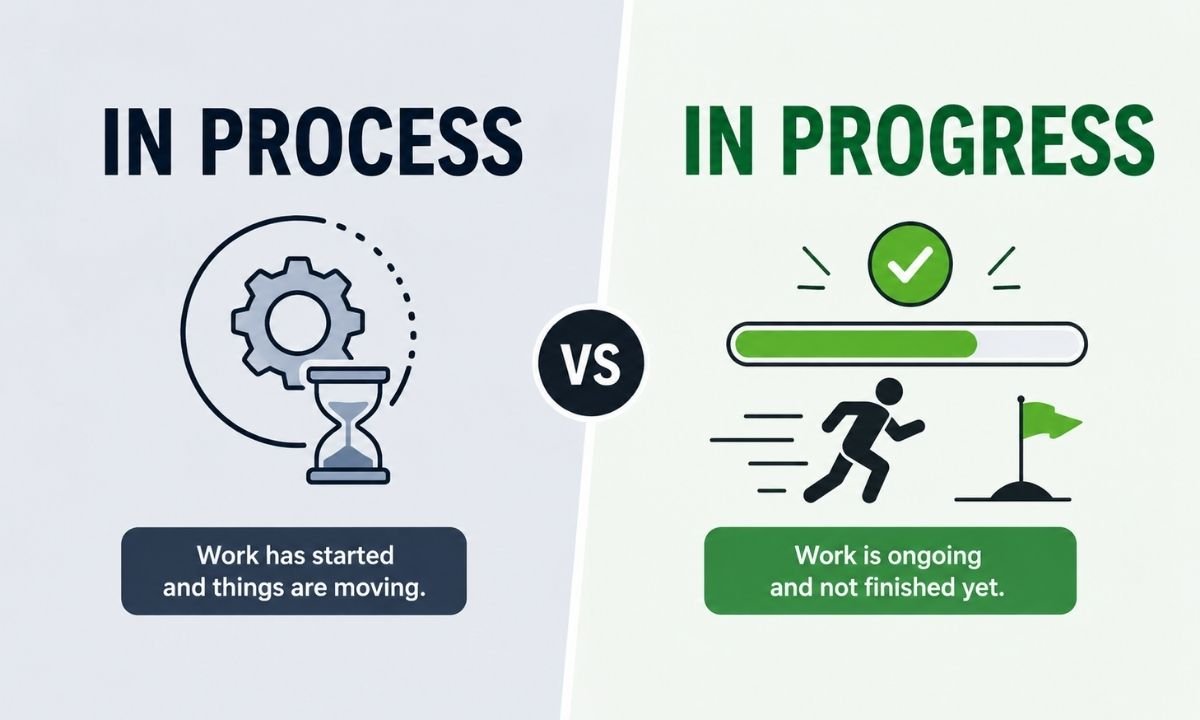
In Process vs In Progress is one of the most common word mix-ups in workplace emails, job applications, and status updates. Both phrases describe something that isn’t finished yet, but they aren’t always interchangeable, and using the wrong one can send a confusing signal to a manager, recruiter, or client.
This guide breaks down the full In Process vs In Progress comparison — exactly when to use each phrase, where they came from, and how different industries apply them — so you never second-guess your wording again.
What “In Process” vs “In Progress” Really Mean
At a glance, the In Process vs In Progress debate comes down to one idea: effort versus system. One phrase highlights active human work, and the other highlights movement through a set of steps.
Meaning of “In Process”
“In process” describes something moving through a defined sequence of steps, a pipeline, or a workflow. It’s less about a person actively working on the task right now and more about the item’s position within a system.
Example: “Your visa application is in process” doesn’t mean an officer is reviewing it at this exact second — it means it has entered the review pipeline.
Meaning of “In Progress”
“In progress” describes an activity that has already started and is actively being worked on. It emphasizes motion toward completion, usually with someone or something visibly engaged in the task.
Example: “The report is in progress” tells you work is happening right now.
Side-By-Side Comparison: “In Process” vs “In Progress”
| Feature | In Process | In Progress |
| Focus | Workflow, pipeline, or system | Active human effort |
| Implies | Movement through required steps | Task is currently being done |
| Common field | Manufacturing, admin, legal, HR | Project management, creative work |
| Tone | Formal, procedural | Active, dynamic |
| Example | “The order is in process.” | “The design is in progress.” |
Where These Words Come From (And Why It Matters)
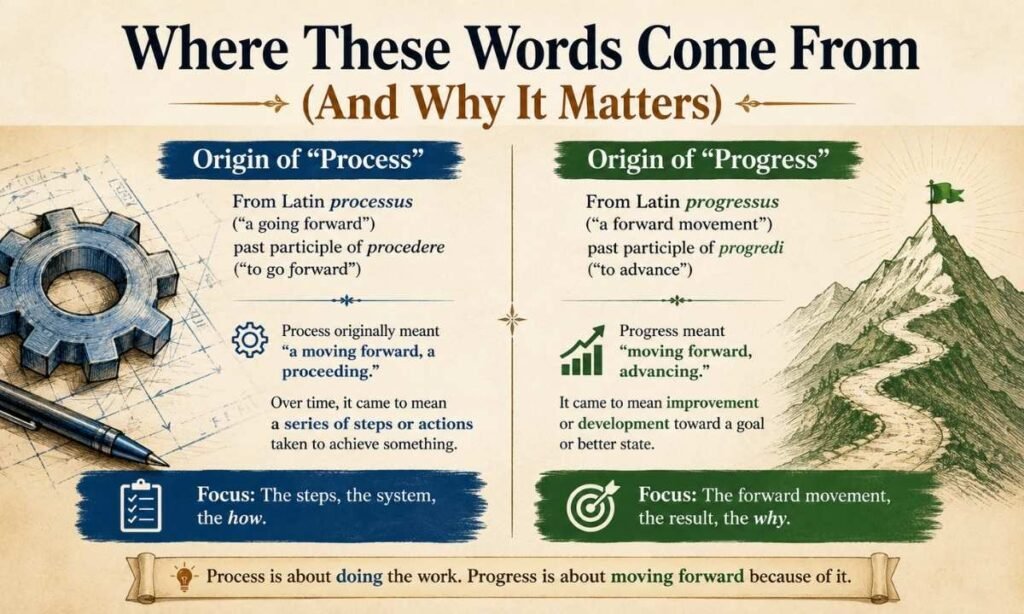
Understanding the roots of these words explains why the In Process vs In Progress confusion exists in the first place.
Origin of “Process”
“Process” comes from the Latin processus, meaning “a going forward” or “advance,” built from procedere — to proceed. Historically, it referred to a series of actions or steps taken to achieve a particular result.
Origin of “Progress”
“Progress” also traces back to Latin, from progressus, meaning “an advance” or “a going forward,” from progredi — to go forward. Despite the similar roots, English usage split the two words: process leans toward structure, and progress leans toward movement and improvement.
Why “In Progress” Is More Common Today
If you search online, “in progress” appears far more often than “in process” in everyday writing. Here’s why.
1. It’s clearer
“In progress” instantly communicates that work is happening. There’s no ambiguity about whether a human or a system is involved.
2. It feels more active
The phrase implies momentum. It sounds like someone is actively pushing the task forward, which is reassuring in status updates.
3. It’s used in project management
Tools like Trello, Jira, and Asana use “In Progress” as a default column label, which has cemented the phrase into modern workplace vocabulary.
4. It works in more contexts
“In progress” fits creative work, construction, research, and personal projects — a wider net than the more procedural “in process.”
In Process vs In Progress Workday
Inside Workday and similar HR platforms, status labels matter a lot to employees checking on requests. Generally:
- “In Process” appears for items like background checks, payroll adjustments, or approvals moving through a system.
- “In Progress” appears for tasks assigned to a specific person, such as an open performance review or an onboarding checklist.
Knowing this distinction helps employees interpret dashboard statuses correctly instead of assuming both labels mean the same thing.
In Process vs In Progress Grammar
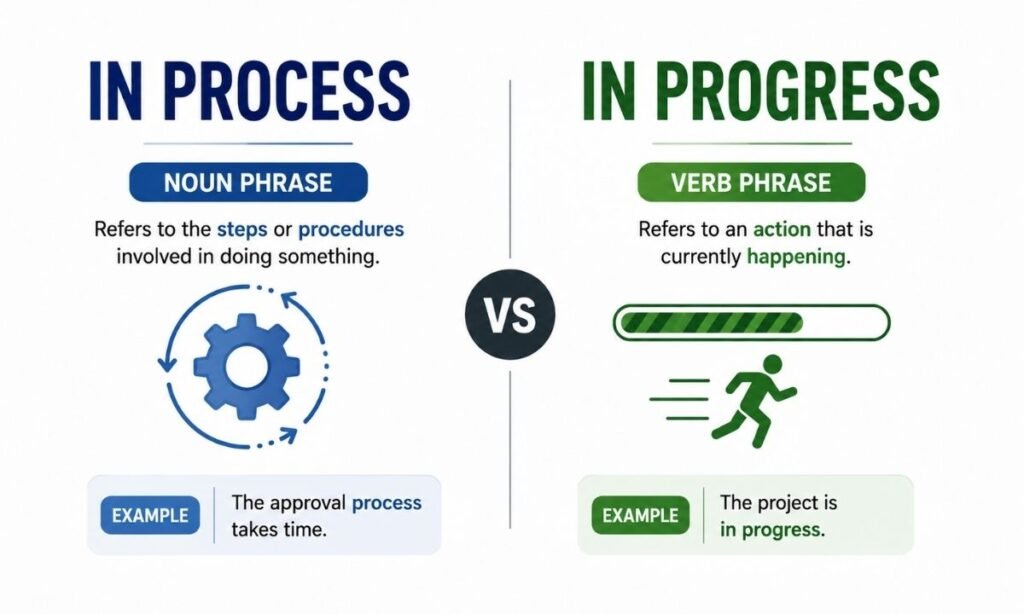
When it comes to In Process vs In Progress grammar, both phrases function as adverbial or adjectival phrases that follow a linking verb (is, are, was, were).
- Correct: “The shipment is in process.”
- Correct: “The shipment is in progress.”
- Incorrect: “The shipment is in-processing progress.” (mixing the two incorrectly)
Neither phrase needs hyphens when used this way, though the compound noun “work-in-process” is often hyphenated in accounting and manufacturing documents.
In Process vs In Progress Examples
These real-world In Process vs In Progress examples show the phrases in action:
- “The refund is currently in process and should post within five business days.”
- “Our new website redesign is in progress and will launch next quarter.”
- “Your background check is in process; HR will notify you once it’s complete.”
- “The mural is still in progress; the artist is adding final details this week.”
When to Use “In Progress” vs. “In Process” (Context-Based Guide)
Choosing correctly in the In Process vs In Progress debate depends on whether you’re describing a task or a system.
Use “In Progress” when:
- Someone is actively completing a task right now
- You’re updating a client or teammate on visible work
- You’re describing creative, technical, or project-based tasks
- You want to sound dynamic and hands-on
Use “In Process” when:
- An item is moving through an official workflow or pipeline
- No single person may be actively touching it at this moment
- You’re referring to administrative, legal, or manufacturing steps
- You want to sound formal or procedural
Comparison Examples (To Make It Crystal Clear)
Example 1
“The loan application is in process.”
It’s moving through underwriting, verification, and approval stages.
Example 2
“The kitchen renovation is in progress.”
Workers are actively on-site building it right now.
Example 3
“The invoice is in process.” vs. “I’m in progress writing the invoice.”
The first describes a system step; the second describes active effort.
These three comparisons sum up the entire In Process vs In Progress argument: one phrase tracks a system, the other tracks a person.
Work In Process or In Progress
In accounting and manufacturing, “work in process” (WIP) is the standard, established term. It refers to partially completed goods sitting between raw materials and finished products on a balance sheet.
“Work in progress” is more common in everyday and creative contexts — a novel, a painting, or a software feature still being built. Both are correct, but industry convention decides which one fits.
| Term | Best Used In |
| Work in Process | Manufacturing, accounting, inventory tracking |
| Work in Progress | Creative fields, general business, everyday speech |
In Process vs In Progress Job Application
Job seekers frequently ask about this exact scenario. If a portal shows “Application in Process,” it usually means your materials have entered the recruiter’s system or are moving through internal review stages — not that someone is reading your resume this second.
“Application in Progress,” on the other hand, more often refers to you, the applicant, still completing the form before submission. Once submitted, most systems switch the status to “in process” or “under review.”
How Different Industries Use “In Process” vs “In Progress”
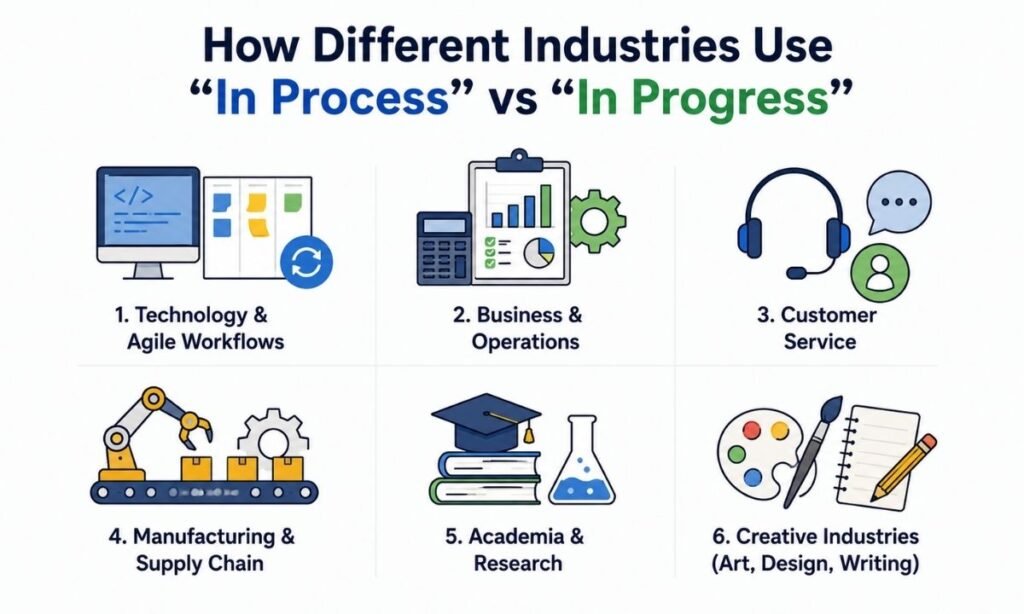
The In Process vs In Progress choice shifts depending on the field, and getting it right builds trust with clients and colleagues.
Technology & Agile Workflows
Agile boards almost always use “In Progress” as a column name for tasks actively being coded, tested, or reviewed by a developer.
Business & Operations
Operations teams often say “in process” for approvals, purchase orders, or compliance checks moving through defined steps.
Customer Service
Support tickets are frequently labeled “in progress” when an agent is actively working the case, and “in process” when it’s queued for a specialized team.
Manufacturing & Supply Chain
“Work in process” is the standard accounting term for goods midway through production.
Academia & Research
Researchers often describe ongoing studies as “in progress” since it reflects active investigation and analysis.
Creative Industries (Art, Design, Writing)
Artists and writers almost exclusively use “in progress” — a painting, novel, or design mockup is “a work in progress.”
Grammar Rules: How to Use Each Phrase Correctly
Getting the grammar right is the final piece of mastering In Process vs In Progress in professional writing.
Sentence Construction
Both phrases typically follow “is,” “are,” “was,” or “were” and act as a predicate adjective describing the subject’s state.
Correct placements
- Subject + linking verb + “in process/progress” (e.g., “The audit is in process.”)
- Noun phrase form: “a work in progress”
Verb Combinations
Pairs with “In Progress”:
- is in progress
- remains in progress
- currently in progress
Pairs with “In Process”:
- is in process
- currently in process
- still in process
Capitalization Notes
Neither phrase is capitalized mid-sentence unless it starts a sentence, appears in a title, or is used as a formal status label on a dashboard (e.g., “In Progress” as a Kanban column heading).
Quick Memory Tricks (Easy to Remember)
Struggling to remember the In Process vs In Progress distinction? Try these.
Mnemonic 1:
“Process = Pipeline.” Both start with P and relate to structured steps.
Mnemonic 2:
“Progress = Person.” If a person is visibly working, use “progress.”
Mnemonic 3:
Think of a factory line (“process”) versus a painter at an easel (“progress”).
Quick Test:
Ask yourself: “Is someone actively doing this, or is it moving through a system?” Active effort = progress. System movement = process.
Common Mistakes (Avoid These)
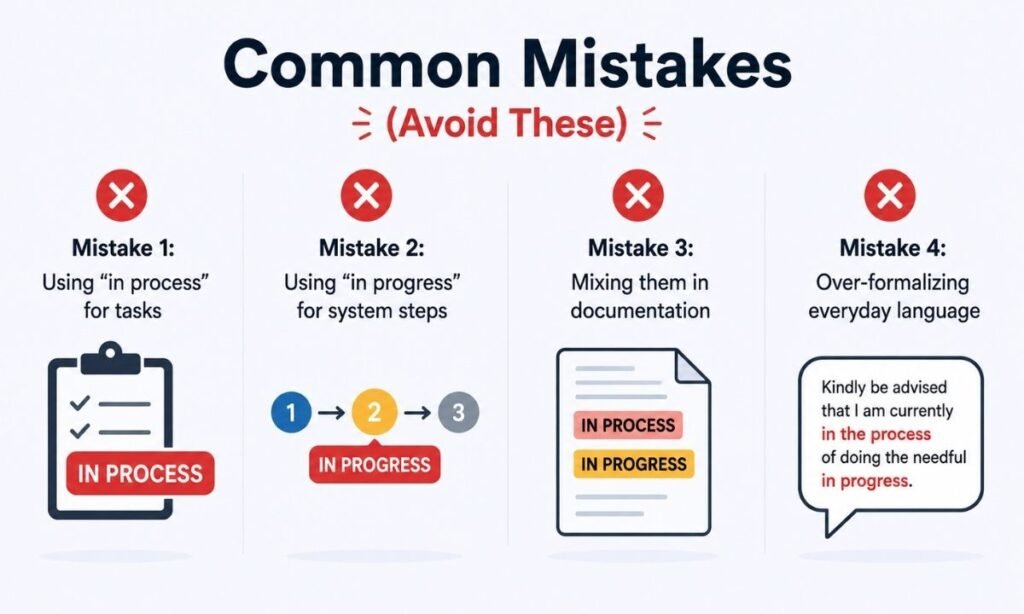
Even experienced writers slip up on In Process vs In Progress. Watch for these patterns.
Mistake 1: Using “in process” for tasks
Saying “My essay is in process” sounds stiff. “In progress” fits creative, personal work better.
Mistake 2: Using “in progress” for system steps
Telling a customer their refund is “in progress” when it’s really sitting in an automated queue can set the wrong expectation.
Mistake 3: Mixing them in documentation
Switching randomly between “in process” and “in progress” within the same report confuses readers and looks inconsistent.
Mistake 4: Over-formalizing everyday language
Not every casual update needs formal phrasing — sometimes “still working on it” communicates more clearly than either term.
Real Case Study: A Technical Team Miscommunication
A software team once labeled a bug ticket “in process” instead of “in progress” on their sprint board. A stakeholder assumed no engineer was actively assigned yet, since “in process” suggested a queued item rather than active work. This caused a two-day delay in follow-up, simply because of phrasing that didn’t match the team’s intended meaning. It’s a small but real example of how In Process vs In Progress wording affects real deadlines.
Another Case Study: Manufacturing Confusion
A supplier reported that a batch of parts was “in progress” when, in accounting terms, they were technically “work in process” inventory sitting in a holding stage awaiting the next production step. The client expected active assembly work, but the parts were simply waiting in the pipeline — a classic In Process vs In Progress mismatch that delayed shipment planning.
Helpful Quotes to Remember
- “Progress is impossible without change.” — a reminder that “progress” always implies forward motion.
- “A process is only as strong as its weakest step.” — a reminder that “process” is about structure, not speed.
FAQs
Is it better to say “in process” or “in progress”?
“In progress” is more common and versatile for everyday and professional use, while “in process” fits formal, workflow-based situations better.
Is it work in process or work in progress?
“Work in process” is standard in accounting and manufacturing; “work in progress” is standard everywhere else, including creative fields.
What is the difference between “progress” and “process”?
“Progress” means forward movement or improvement, while “process” means a structured series of steps or actions.
What is another way to say “in process”?
Alternatives include “underway,” “being processed,” “pending,” or “in the pipeline.”
Does “in progress” mean the same as “ongoing”?
Not exactly — “ongoing” suggests something continuous with no clear end date, while “in progress” implies a task heading toward completion.
Can “in process” and “in progress” be used interchangeably?
Sometimes, but precise writers weigh the In Process vs In Progress distinction and reserve “in process” for systems and “in progress” for active human effort to avoid ambiguity.
Why do job portals say “application in process”?
It usually means your application has left the applicant’s control and entered the employer’s internal review pipeline.
Is “in process of” grammatically correct?
Yes, as in “in the process of reviewing,” though many editors prefer simplifying it to “currently reviewing” for cleaner writing.
What does “order in process” mean on a shipping site?
It means the order has been received and is moving through fulfillment steps like packing and labeling, but hasn’t shipped yet.
Conclusion
Mastering In Process vs In Progress pays off in every status update you write. The distinction isn’t just a grammar technicality — it shapes how clearly you communicate status to teammates, clients, and applicants. Use “in progress” when active human effort is happening right now, and reach for “in process” when something is simply moving through a defined workflow or system.
Once you internalize this difference, you’ll never second-guess a status update, job application tracker, or project report again and your writing will sound sharper, clearer, and more professional every time.

Hi, I’m Alex Carter, a passionate content creator and language enthusiast dedicated to exploring the true meanings behind words, phrases, and modern slang. With over 5 years of experience in content research and digital publishing, I specialize in breaking down complex terms into simple explanations. I focus on delivering well-researched, up-to-date, and SEO-optimized content that answers real user queries.