

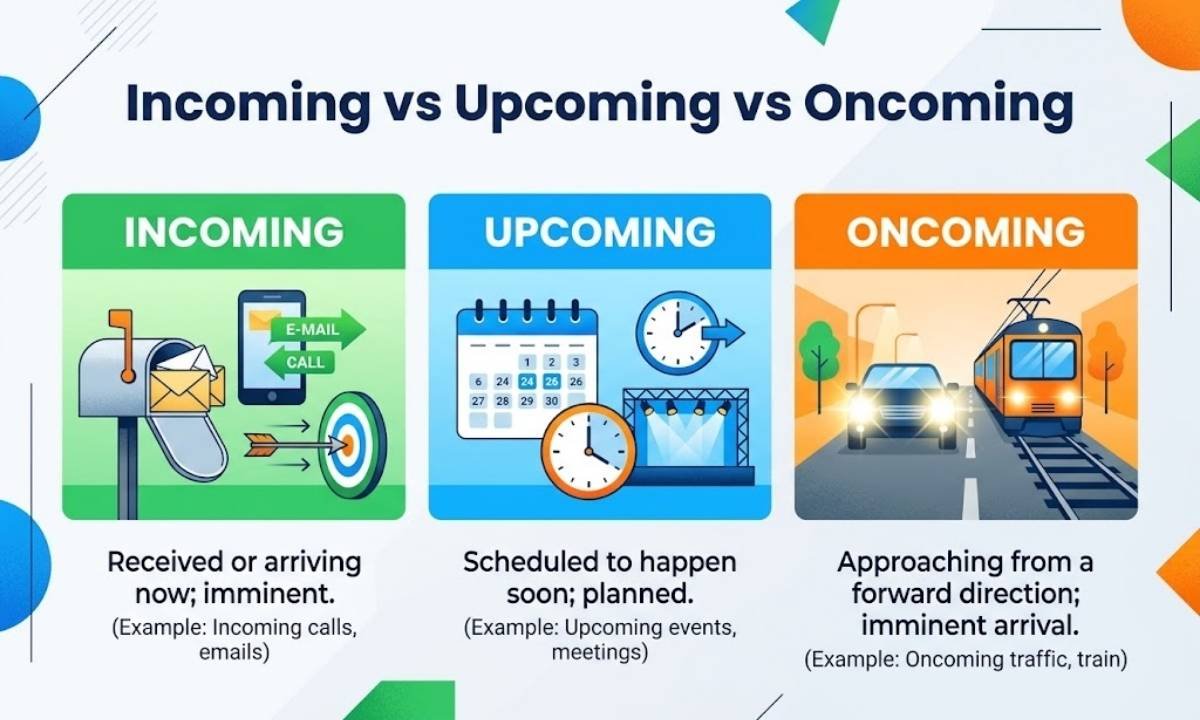
Incoming vs Upcoming vs Oncoming trips up even confident English speakers because all three words describe something that hasn’t arrived yet. A phone buzzes with a text, a concert sits on next month’s calendar, a truck barrels down the opposite lane — English uses a different word for each situation, and mixing them up makes your sentences sound slightly “off,” even if native listeners can’t always explain why.
This guide breaks the confusion apart for good. You’ll learn what each word actually means, where it fits naturally, and how to choose the right one without pausing mid-sentence to second-guess yourself. By the end, the debate of incoming vs upcoming vs oncoming will feel less like grammar homework and more like common sense.
Understanding “Incoming”, “Upcoming”, and “Oncoming”
All three words share a Germanic root in “coming,” which is exactly why they feel interchangeable at first glance. But each prefix — in-, up-, and on- — points the word in a completely different direction: arrival, timing, or physical motion.
Before comparing them side by side, it helps to look at each word on its own — this is the foundation for mastering incoming vs upcoming vs oncoming once and for all.
What “Incoming” Really Means
Definition of Incoming
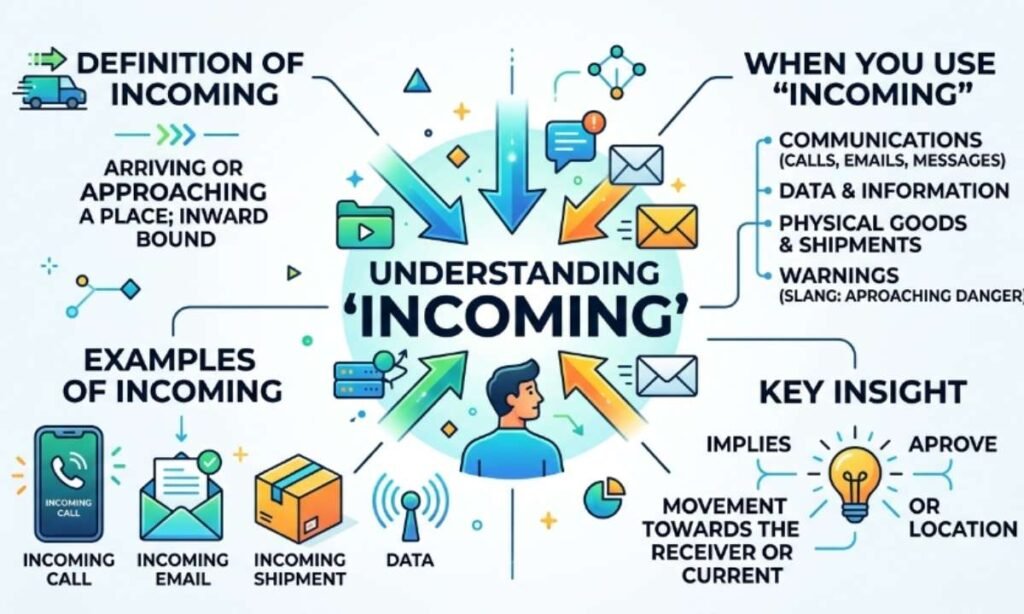
“Incoming” describes something that is arriving, entering, or being received at a specific location, device, or system right now or very soon. The focus is on the act of arrival itself — a call reaching your phone, a shipment reaching a warehouse, a new hire reaching a company.
When You Use “Incoming”
Understanding this piece of the incoming vs upcoming vs oncoming puzzle matters most in tech, logistics, and safety contexts. The word shows up across several everyday categories.
Tech & Communication
- “You have an incoming call.”
- “Check your incoming messages.”
Deliveries & Logistics
- “The incoming shipment is delayed.”
- “New incoming stock arrives Monday.”
Weather & Natural Forces
- “An incoming cold front will hit the region tonight.”
Emergencies & Warnings
- “Incoming missile detected.”
- “Brace for incoming turbulence.”
Examples of Incoming
- The incoming flight lands at 6 p.m.
- We have three incoming emails from the client.
- Security flagged an incoming threat on the network.
Key Insight
Whenever the question of incoming vs upcoming vs oncoming comes up, remember that “incoming” is almost always tied to arrival — physical or digital — at a defined destination.
What “Upcoming” Really Means
Definition of Upcoming
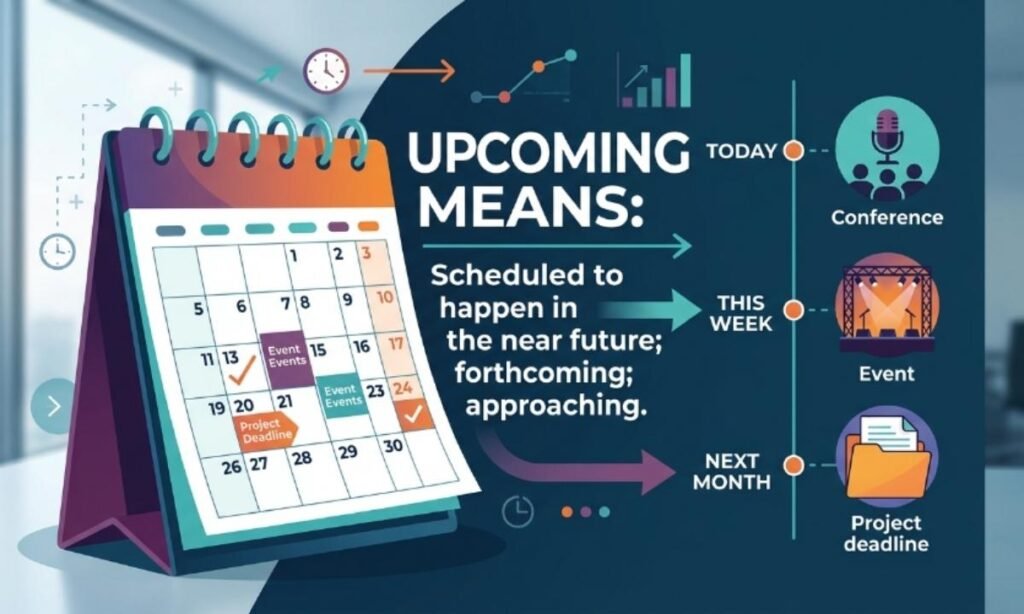
“Upcoming” describes something scheduled, planned, or expected to happen in the near future. Unlike “incoming,” there’s no sense of physical movement toward you — it’s purely about timing.
Practical Uses of “Upcoming”
In the incoming vs upcoming vs oncoming framework, “upcoming” attaches naturally to anything with a date attached to it: events, releases, deadlines, appointments, and announcements.
Examples
- The upcoming election is generating a lot of debate.
- Our upcoming product launch is set for October.
- Don’t forget the upcoming meeting on Thursday.
Typical Daily Uses
- Upcoming birthdays and anniversaries
- Upcoming holidays or festivals
- Upcoming deadlines at work or school
- Upcoming movie releases
Key Insight
If you’re weighing incoming vs upcoming vs oncoming and nothing is physically moving anywhere, “upcoming” is your word. It lives entirely on the calendar.
What “Oncoming” Really Means
Definition of Oncoming
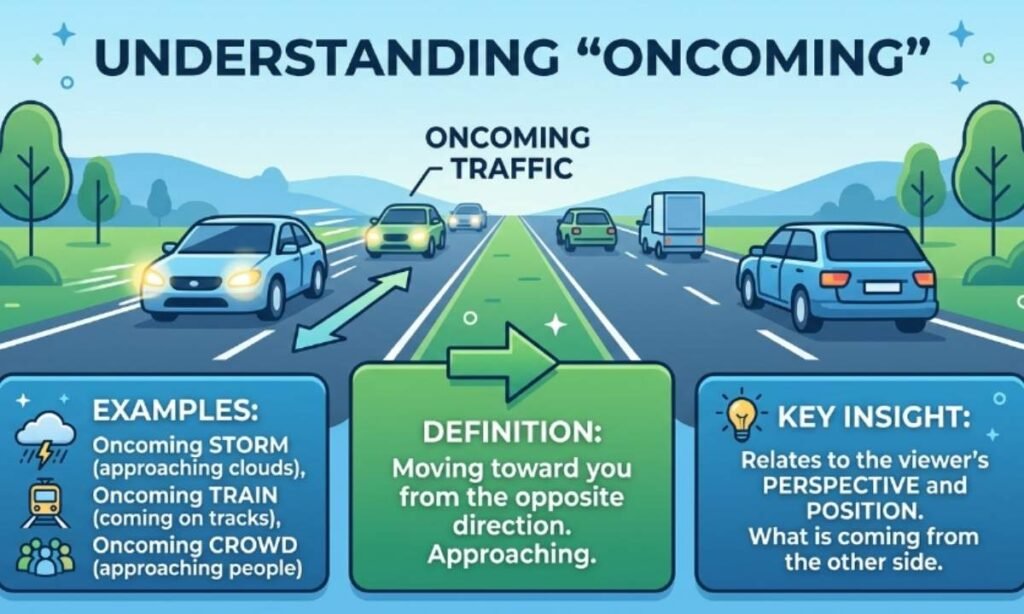
“Oncoming” describes something physically moving directly toward you or toward a specific point, often carrying a hint of urgency or danger. In any incoming vs upcoming vs oncoming comparison, this is the most visual and motion-driven of the three words.
Common Uses of “Oncoming”
Traffic & Vehicles
- “Watch for oncoming traffic before you turn.”
Danger & Physical Threats
- “The soldiers braced for the oncoming attack.”
Weather
- “Residents evacuated ahead of the oncoming storm.”
Examples
- The cyclist swerved to avoid an oncoming car.
- Sailors watched the oncoming waves grow taller.
- She stepped back from the oncoming crowd.
Key Insight
Out of the three, “oncoming” is the only one that always implies physical, visible motion toward a fixed point — which is the fastest way to settle any incoming vs upcoming vs oncoming debate.
Side-by-Side Comparison
This table lays out the incoming vs upcoming vs oncoming distinctions at a glance.
Meaning Differences Table
| Word | Core Meaning | Involves Motion? | Typical Use |
| Incoming | Arriving now or very soon | Sometimes (digital or physical) | Calls, emails, shipments, flights |
| Upcoming | Scheduled for the future | No | Events, deadlines, releases |
| Oncoming | Moving directly toward you | Yes, always physical | Traffic, storms, danger |
Best Word Choice by Scenario
| Scenario | Correct Word |
| A text message about to land on your phone | Incoming |
| A conference happening next month | Upcoming |
| A car driving toward you in the opposite lane | Oncoming |
| A hurricane forecast for next week | Upcoming |
| A hurricane currently heading your way | Incoming or Oncoming |
| A new employee starting Monday | Incoming |
Incoming vs Upcoming vs Oncoming Synonym
If you need quick substitutes:
- Incoming → arriving, inbound, approaching
- Upcoming → forthcoming, scheduled, planned
- Oncoming → approaching, advancing, nearing (with motion implied)
Why Context Matters
Choosing correctly among incoming vs upcoming vs oncoming comes down to answering three simple questions, and once you know how to ask them, the right word almost picks itself.
1. Is it physically moving toward you?
If yes, and it’s visible or tangible — a vehicle, a wave, a crowd — “oncoming” fits best.
2. Is it arriving to your device, system, or location?
If something is landing in your inbox, phone, airport, or warehouse, “incoming” is the natural choice.
3. Is it planned for the future?
If it’s sitting on a calendar with a date attached and nothing is moving anywhere, “upcoming” is correct.
Examples from Everyday Life
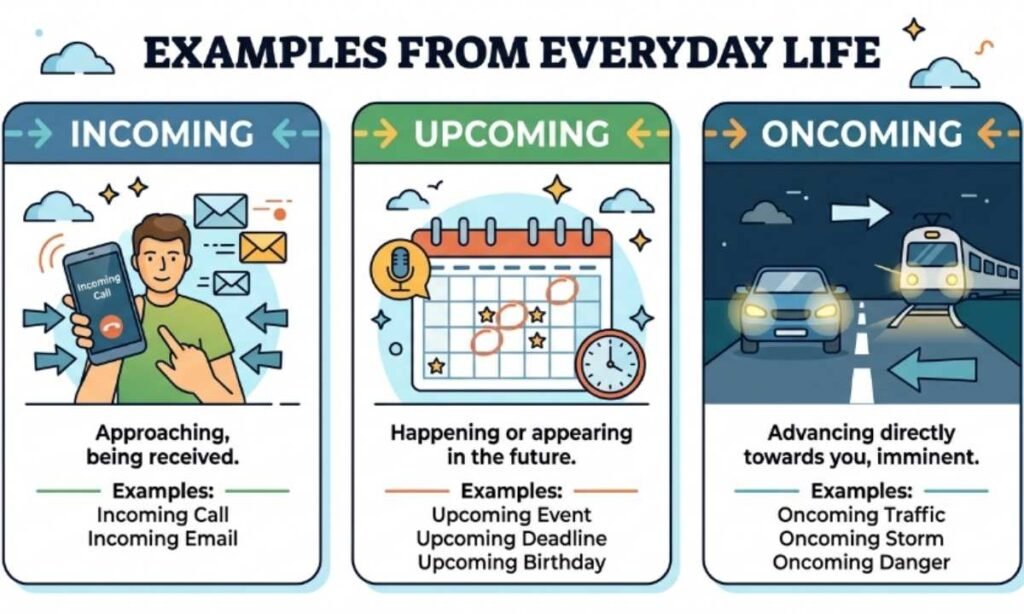
Incoming
- “I missed an incoming call from my dentist.”
- “The incoming tide covered the sandbar within an hour.”
Upcoming
- “Tickets for the upcoming show sell out fast.”
- “She’s preparing notes for her upcoming interview.”
Oncoming
- “He flashed his headlights at the oncoming driver.”
- “The hikers heard an oncoming thunderstorm in the distance.”
Common Mistakes to Avoid
Getting incoming vs upcoming vs oncoming wrong usually falls into one of these five common patterns, so keep an eye out for them in your own writing.
- Using “oncoming” for events: “Oncoming meeting” is incorrect. Meetings don’t physically move; use “upcoming meeting.”
- Using “incoming” for scheduled things: “Incoming wedding” sounds odd. Use “upcoming wedding” since it’s a planned date, not an arrival.
- Using “upcoming” for something happening now: “Upcoming call” is wrong if the phone is ringing right now. That’s “incoming call.”
- Using “oncoming” for digital stuff: Messages, emails, and notifications don’t approach you through space, so “oncoming message” is incorrect.
- Using “incoming” for things that don’t move: A festival isn’t “incoming”; it’s “upcoming,” since it stays fixed on a date rather than arriving anywhere.
Easy Memory Tricks
These simple tricks make the incoming vs upcoming vs oncoming decision almost automatic.
- Incoming = In-coming: something is coming in to a place, inbox, or device.
- Upcoming = Up next: think of it as next on the schedule.
- Oncoming = On the way toward you: picture headlights coming straight at your car.
- The Car Rule: if a vehicle is involved and it’s heading your way, it’s oncoming.
- The Calendar Rule: if it has a date circled on a calendar, it’s upcoming.
Case Studies
These real-world snapshots show incoming vs upcoming vs oncoming used correctly, side by side, in ordinary situations.
Case Study 1: The Weather App
A weather app alert reads, “Incoming storm expected within the hour,” while the seven-day forecast lists an “upcoming storm system” for next weekend. The first uses “incoming” because the storm is arriving soon; the second uses “upcoming” because it’s still just a forecast on the calendar.
Case Study 2: A Company Announcement
An HR email announces an “incoming new hire” starting Monday and an “upcoming town hall” scheduled for next month. One is about arrival, the other about a scheduled event — a clean example of incoming vs upcoming vs oncoming used correctly in the same message.
Case Study 3: Traffic Incident
A news report describes a driver who “swerved to avoid oncoming traffic” during a sudden downpour, while a separate line notes “upcoming roadwork” planned for next week. The distinction between motion happening now and a plan for later couldn’t be clearer.
Quotes to Help You Remember
- “If it’s moving toward you, it’s oncoming. If it’s arriving, it’s incoming. If it’s just on the calendar, it’s upcoming.”
- “Motion equals oncoming. Timing equals upcoming. Arrival equals incoming.”
FAQs
Here are quick answers to the most common questions people ask about incoming vs upcoming vs oncoming.
What is the main difference between incoming, upcoming, and oncoming?
Incoming refers to arrival, upcoming refers to future timing, and oncoming refers to physical motion toward you.
Can “incoming” and “oncoming” be used interchangeably?
No. Incoming can apply to digital or physical arrivals, while oncoming always implies visible, physical movement toward a point.
Is “oncoming event” correct?
No, “oncoming event” is incorrect. Events don’t move physically, so “upcoming event” is the right phrase.
Which word describes a scheduled meeting?
“Upcoming” is correct for a scheduled meeting since it’s about timing, not arrival or motion.
Which word describes a car in the opposite lane?
“Oncoming” is correct because it involves direct physical motion toward you.
Is “incoming call” or “upcoming call” correct?
“Incoming call” is correct because the call is actively arriving on your phone right now.
Does “oncoming” always mean danger?
Not always, but it frequently appears in contexts involving traffic, storms, or threats because those situations involve motion toward a person or place.
Can weather be described with all three words?
Yes. A storm can be “upcoming” when it’s forecast, “incoming” as it nears your area, and “oncoming” when it’s visibly approaching.
How can I quickly decide between incoming, upcoming, and oncoming?
Ask whether it’s arriving (incoming), scheduled (upcoming), or physically moving toward you (oncoming), and pick accordingly.
Conclusion
The comparison of incoming vs upcoming vs oncoming really comes down to three simple ideas: arrival, timing, and motion. “Incoming” belongs to anything landing on your phone, desk, or doorstep. “Upcoming” belongs to anything sitting on your calendar with a future date. “Oncoming” belongs to anything you can physically see heading your way, often on the road or in the weather.
Once you internalize these three lanes — arrival, schedule, and motion — the incoming vs upcoming vs oncoming puzzle stops being confusing. Use the memory tricks, revisit the comparison table when in doubt, and soon these words will come naturally, without a second thought.

Hi, I’m Alex Carter, a passionate content creator and language enthusiast dedicated to exploring the true meanings behind words, phrases, and modern slang. With over 5 years of experience in content research and digital publishing, I specialize in breaking down complex terms into simple explanations. I focus on delivering well-researched, up-to-date, and SEO-optimized content that answers real user queries.