

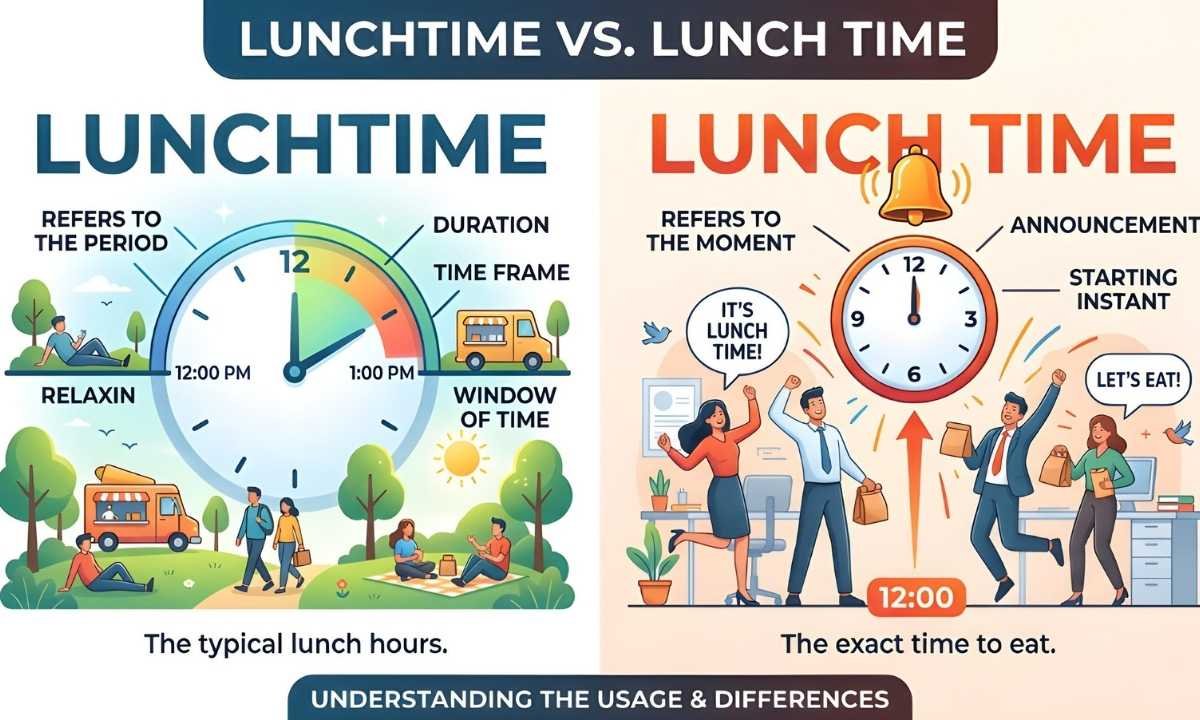
Lunchtime vs. Lunch Time is one of those small grammar puzzles that trips up even confident English speakers. You’ve probably typed “lunchtime” in one email and “lunch time” in the next, without ever stopping to wonder which one is actually correct. The truth is, both forms exist in English for real reasons, and knowing when to use each one will make your writing look sharper and more polished.
In this guide, we’ll walk through the grammar, the history, the regional quirks, and the everyday habits behind these two words. By the end, the Lunchtime vs. Lunch Time debate won’t confuse you again.
Understanding Lunchtime vs. Lunch Time
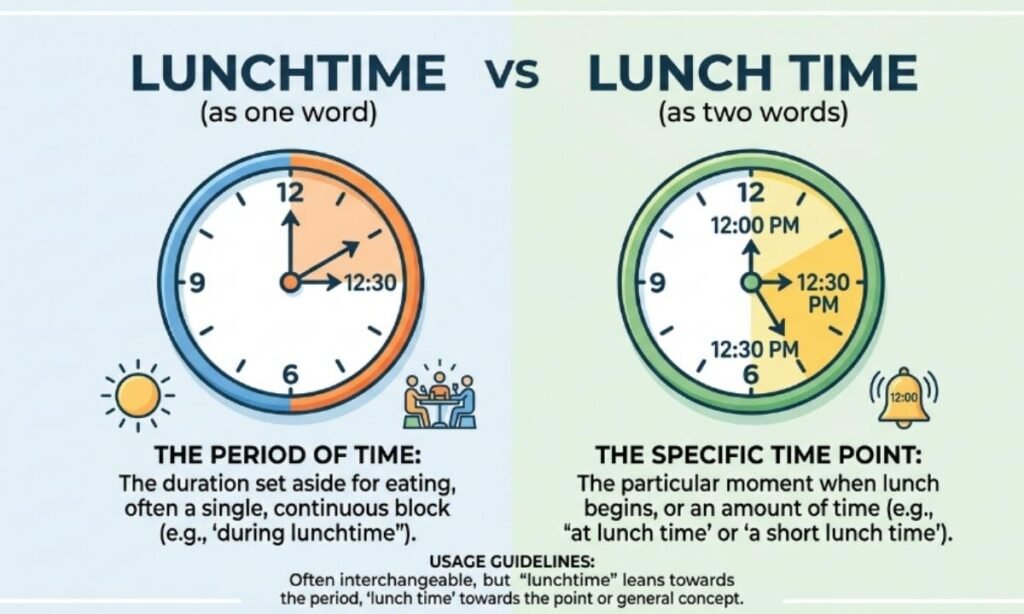
At a glance, the two forms look almost identical. One is written as a single compound word, and the other keeps the words separated with a space. That single space, though, carries a bit of grammatical weight.
“Lunchtime” is a closed compound noun. It refers to the general stretch of the day when people eat lunch — a broad, familiar chunk of time, much like “morning” or “evening.” “Lunch time,” on the other hand, is a noun phrase made up of two separate words: “lunch” and “time.” It leans slightly more toward a specific, scheduled moment.
So when you’re weighing Lunchtime vs. Lunch Time, think of it this way: one word describes a period, and two words describe a point on the clock. Keeping this distinction in mind is the fastest way to settle the Lunchtime vs. Lunch Time question for good.
Lunchtime or Lunch Time Synonym
If you need a quick substitute while writing, consider these alternatives:
- Midday break
- Noon hour
- Lunch break
- Lunch period
- Midday meal time
These synonyms work well when you want to avoid repeating “lunchtime” or “lunch time” too often in the same paragraph.
What Each Term Really Means
Before comparing usage patterns, it helps to pin down exactly what each side of the Lunchtime vs. Lunch Time pair actually means.
Definition of “Lunchtime”
Lunchtime is a single compound noun meaning the customary time of day set aside for eating lunch, generally somewhere between late morning and early afternoon.
Quick Example
“The office empties out at lunchtime every day.”
Definition of “Lunch Time”
Lunch time is a two-word noun phrase that emphasizes the actual clock time allotted for a lunch break, often in a scheduling or timetable context.
Quick Example
“Our lunch time is from 12:00 to 1:00 PM.”
Grammar Rules Behind Both Forms
English constantly reshapes itself, and compound words are a big part of that evolution. Understanding the grammar behind Lunchtime vs. Lunch Time helps explain why one form has become dominant, and it also clears up why so many writers still hesitate over Lunchtime vs. Lunch Time in formal documents.
Lunchtime or Lunch Time Meme
Online, this debate has even become a running joke. Grammar meme pages love poking fun at people who agonize over “lunchtime” versus “lunch time,” comparing it to bigger arguments like Oxford commas or “affect vs. effect.” It’s a lighthearted reminder that while the rule matters, nobody’s making a huge mistake either way.
Compound Nouns Becoming One Word
English has a long history of merging frequently paired words into a single term. “Weekend,” “notebook,” and “sunrise” all started as two-word phrases before fusing together. “Lunchtime” followed the same path, and today, major dictionaries — including Merriam-Webster — list it as one word.
Hyphenation Notes
You’ll rarely, if ever, see a correct use of “lunch-time” with a hyphen. English compound nouns typically move through three stages:
- Open form (two words): lunch time
- Hyphenated form: lunch-time
- Closed form (one word): lunchtime
“Lunchtime” has largely settled into stage three, though “lunch time” still survives in casual and older writing.
Formality Levels
| Aspect | Lunchtime | Lunch Time |
| Word type | Compound noun | Noun phrase |
| Formality | Slightly more formal/modern | Slightly more casual/traditional |
| Common context | Everyday speech, conversation | Schedules, timetables, emails |
| Dictionary status | Standard entry | Recognized but less common |
Practical Usage: When to Choose One Over the Other

Once you understand the grammar, the Lunchtime vs. Lunch Time choice becomes a matter of context rather than correctness.
Everyday Usage
In casual speech and general writing, “lunchtime” wins by a wide margin. Native speakers naturally say things like “See you at lunchtime” or “I’m starving, it’s almost lunchtime.” This is the safest default choice for blog posts, emails, and daily conversation.
When “Lunch Time” Makes Sense
“Lunch time” fits better when you’re pointing to a specific, scheduled slot, especially in formal or structured documents:
- Employee handbooks: “Lunch time is 12:30 to 1:15 PM.”
- School timetables: “Lunch time begins after third period.”
- Official memos where “time” is being emphasized as a measurable duration
Historical Development of the Term
Looking at the Lunchtime vs. Lunch Time story through history makes the modern preference easier to understand.
Early Appearances
The concept of a fixed midday meal break became more common during the Industrial Revolution, when factory schedules required workers to have a designated pause for eating. Written references to “lunch time” as two words appeared in the 18th and 19th centuries, before compounding trends took hold.
Language Trend
As the phrase was used more frequently, English did what it usually does with high-frequency word pairs — it merged them. By the 20th century, “lunchtime” had become the standard spelling in most dictionaries and style guides, while “lunch time” persisted mainly in older texts and specific formal contexts.
Regional and Cultural Usage Differences
The Lunchtime vs. Lunch Time preference also shifts slightly depending on where in the English-speaking world you are.
Usage in English-Speaking Countries
United States
American English strongly favors “lunchtime” as one word in both casual and professional writing.
United Kingdom
British English also prefers “lunchtime,” though “lunch time” still appears occasionally in older or more formal British documents.
Canada
Canadian English generally mirrors American conventions, using “lunchtime” as the default.
Australia
Australian English follows the same broad trend, with “lunchtime” dominating everyday speech and writing.
Cross-Cultural Interpretations of Lunchtime
The word doesn’t just change spelling across cultures — the actual concept of lunchtime shifts too.
Mediterranean Countries
In countries like Spain and Italy, lunchtime often stretches later into the afternoon (sometimes 2:00 PM or beyond) and can last much longer than a typical American lunch break.
Northern Europe
Countries such as Germany and the Netherlands tend to keep lunchtime shorter and earlier, often around midday, reflecting more structured workday routines.
Asian Countries
In many Asian countries, lunchtime is a well-defined, often communal event, with set hours built firmly into school and office schedules.
Lunchtime in Daily Life
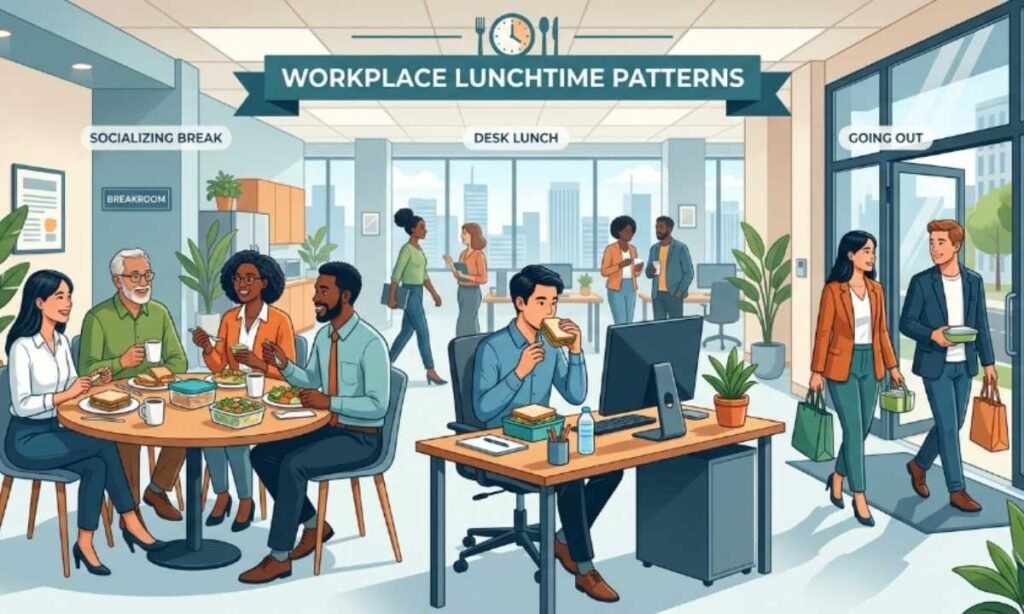
Beyond grammar, the Lunchtime vs. Lunch Time distinction shows up in how different settings structure the midday break.
Workplace Lunchtimes
Most offices designate a set lunchtime window, commonly between 30 minutes and an hour, though this varies heavily by company culture and country labor laws.
Interesting Workplace Patterns
- Many employees eat lunch at their desks rather than taking a full break.
- Remote workers often have more flexible, self-scheduled lunchtimes.
- Some companies use staggered lunchtimes to keep operations running continuously.
School Lunchtimes
Elementary School
Younger students typically get shorter, earlier lunchtimes, often paired with recess.
Middle & High School
Lunchtime periods shift later and shorten slightly as students move through grade levels, usually fitting into a tighter class schedule.
University
College students often have the most flexible lunchtime of all, choosing when and where to eat based on their individual class schedules.
Lunchtime Etiquette and Social Expectations
Regardless of which spelling you use, the Lunchtime vs. Lunch Time habits below apply to both.
General Etiquette
- Avoid strong-smelling or noisy foods in shared spaces.
- Keep conversations light and professional if dining with colleagues.
- Be mindful of time limits so others aren’t left waiting.
- Clean up after yourself in shared break rooms.
Cultural Etiquette Examples
In many Mediterranean cultures, lunchtime is treated as a social event meant to be savored, not rushed. In contrast, in fast-paced corporate environments in the U.S. or U.K., lunchtime is often treated as a brief, functional pause between tasks.
Common Misconceptions
Let’s clear up a few myths that keep the Lunchtime vs. Lunch Time confusion alive.
❌ “Lunchtime” always means noon.
Not true. Lunchtime varies by culture, workplace, and personal routine — it can happen anywhere from late morning to mid-afternoon.
❌ “Lunch time” is incorrect.
Also false. It’s grammatically valid, just less common than the compound form “lunchtime.”
❌ Both terms mean the exact same thing.
They’re closely related but not identical — “lunchtime” describes a general period, while “lunch time” leans toward a specific scheduled moment.
❌ “Lunchtime” is British and “lunch time” is American.
This isn’t accurate either. Both English-speaking regions use “lunchtime” as the dominant, modern form.
Related Mealtime Expressions
The Lunchtime vs. Lunch Time pattern isn’t unique — other mealtime words follow a similar path toward compounding.
- Breakfast time (never “breakfasttime”)
- Dinnertime (one word, like lunchtime)
- Suppertime (one word)
- Teatime (one word, mainly British usage)
- Snack time (two words)
Notice that not every mealtime word compounds the same way — English compounding is driven by usage frequency, not a strict universal rule.
Examples in Real Sentences

Seeing the Lunchtime vs. Lunch Time difference in action makes the rule stick faster than any explanation.
Using “Lunchtime”
- “Lunchtime is my favorite part of the workday.”
- “The café gets crowded at lunchtime.”
- “Let’s catch up during lunchtime tomorrow.”
Using “Lunch Time”
- “What time is lunch time at your school?”
- “Lunch time has been moved to 1:00 PM this week.”
- “Please confirm your lunch time before scheduling the meeting.”
Side-by-Side Comparison
Here’s a quick Lunchtime vs. Lunch Time snapshot you can reference anytime you’re unsure which form to use.
| Feature | Lunchtime | Lunch Time |
| Word count | One word | Two words |
| Grammar role | Compound noun | Noun phrase |
| Emphasis | The general period | The specific moment |
| Common setting | Casual speech, blogs, everyday writing | Schedules, timetables, formal memos |
| Dictionary preference | Preferred standard form | Acceptable, less common |
| Regional favorite | Preferred in US, UK, Canada, Australia | Appears in formal/older documents worldwide |
FAQs
Here are the most common questions people ask about Lunchtime vs. Lunch Time.
Is it “lunchtime” or “lunch time”?
“Lunchtime” is the standard, dictionary-recognized spelling for most everyday writing, though “lunch time” is still grammatically acceptable.
What is the correct grammar for lunchtime?
“Lunchtime” is a closed compound noun and should be written as a single word without a hyphen or space.
Is “lunch time” two words or one?
It can be written either way, but “lunchtime” as one word is far more common in modern English.
Does Merriam-Webster recognize “lunchtime” as one word?
Yes, major dictionaries list “lunchtime” as the standard one-word spelling.
Why is “breakfast time” not one word like “lunchtime”?
Compounding depends on how frequently a phrase is used together over time, and “breakfast time” simply hasn’t merged the same way “lunchtime” has.
Can “lunch time” be used in formal writing?
Yes, especially in schedules, timetables, and official documents where the specific time slot is being emphasized.
What time do most people take their lunchtime break?
In many Western countries, lunchtime typically falls between 12:00 PM and 1:30 PM, though this varies by workplace and culture.
Is “lunchtime” different in British and American English?
No, both regions favor “lunchtime” as the standard modern form.
How long does a typical lunchtime last?
Most workplace lunchtimes last between 30 minutes and one hour, though Mediterranean countries often allow longer breaks.
Conclusion
At the end of the day, the Lunchtime vs. Lunch Time debate ultimately comes down to context and consistency. “Lunchtime” is the modern, widely accepted compound noun that fits almost every everyday situation, while “lunch time” still holds its place in formal scheduling and traditional writing. Neither form is truly wrong — but understanding the subtle difference between them will make your writing feel more intentional and polished. The next time you sit down to write about the midday break, you’ll know exactly which version fits your sentence best.

Hi, I’m Alex Carter, a passionate content creator and language enthusiast dedicated to exploring the true meanings behind words, phrases, and modern slang. With over 5 years of experience in content research and digital publishing, I specialize in breaking down complex terms into simple explanations. I focus on delivering well-researched, up-to-date, and SEO-optimized content that answers real user queries.