


Pre vs Post is one of the most common word-pair confusions in English, and getting it wrong can change the entire meaning of a sentence. Whether you’re filling out a tax form, reading a medical report, or trying to understand a startup valuation, knowing the difference between “pre” and “post” instantly makes technical language easier to understand. This guide breaks down everything you need to know — from grammar rules to real-world examples in medicine, finance, education, and business.
Understanding What “Pre” and “Post” Mean
At the simplest level, “pre” means before, and “post” means after. Both are prefixes — small word parts attached to the front of a root word to shift its meaning in time. When you see these prefixes attached to almost any noun or verb, you’re really looking at a compressed timeline: something that happens ahead of an event (pre-) or something that happens once the event is over (post-).
This before-and-after relationship applies whether you’re talking about a “pre-game” show or a “post-game” interview, a “pre-surgery” checklist or “post-surgery” recovery.
The Origins of “Pre” and “Post”
Both prefixes come from Latin roots that have survived almost unchanged into modern English:
- Pre- comes from the Latin prae, meaning “before” or “in front of.”
- Post- comes from the Latin post, meaning “after,” “behind,” or “later.”
Because so much of English scientific, medical, and legal vocabulary is built on Latin, these prefixes show up constantly in formal writing. Understanding their Latin origin makes the Pre vs Post distinction much easier to decode the first time you see an unfamiliar word.
How “Pre” Functions in English
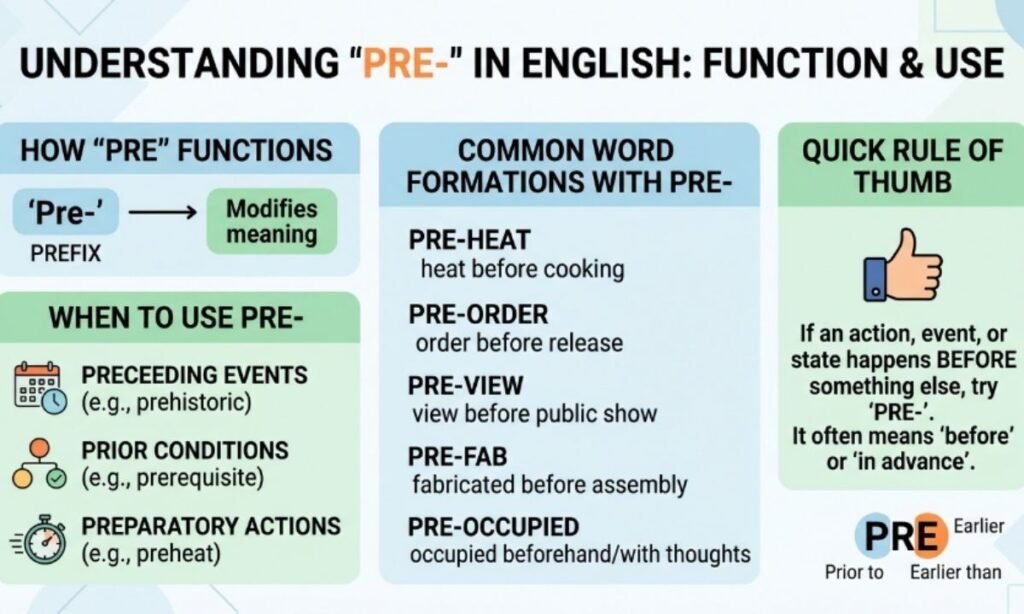
“Pre” functions almost exclusively as a prefix. It attaches directly to a root word (sometimes with a hyphen, sometimes without) to indicate that the action or state described happens earlier than a reference point.
When to Use Pre-
Use “pre-” when you want to describe something that happens:
- Before a scheduled event
- Before a process begins
- In preparation for something
- Ahead of a deadline or milestone
Common Word Formations with Pre-
| Word | Meaning |
| Preview | To view before release |
| Precaution | Care taken before a risk occurs |
| Prehistoric | Before recorded history |
| Preheat | To heat an oven before cooking |
| Premonition | A feeling before something happens |
| Prenatal | Before birth |
Quick Rule of Thumb
If you can replace the prefix with the word “before” and the sentence still makes sense, you’re using “pre-” correctly. For example: “pre-marriage counseling” = “counseling before marriage.”
How “Post” Functions in English
Unlike “pre,” the word “post” is more flexible. It can act as a prefix, noun, verb, or adverb. As a noun, it can mean a wooden pillar, a job position, or a piece of mail. As a verb, it means to publish or display something. But as a prefix, “post” always signals that something occurs after a reference point.
When to Use Post-
Use “post-” when describing something that happens:
- After an event has concluded
- Following a procedure or process
- As a result or aftermath of something
- Later in a sequence or timeline
Common Word Formations with Post-
| Word | Meaning |
| Postpone | To move to a later time |
| Postgraduate | After completing a degree |
| Postpartum | After childbirth |
| Postmortem | After death |
| Post-traumatic | After a traumatic event |
| Postscript | Written after the main letter |
Quick Rule of Thumb
If you can replace the prefix with the word “after” and the meaning still holds, you’re using “post-” correctly. For example: “post-workout stretching” = “stretching after a workout.”
Pre vs Post: A Clear Comparison
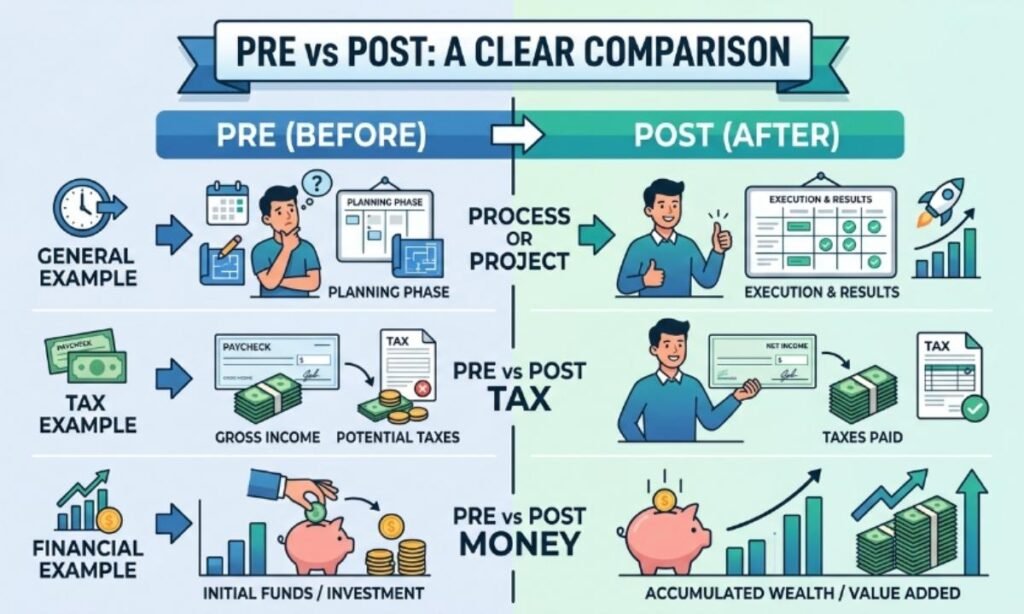
The table below sums up the essential Pre vs Post distinction in one glance.
| Feature | Pre- | Post- |
| Meaning | Before | After |
| Latin Root | prae | post |
| Part of Speech | Prefix only | Prefix, noun, verb, adverb |
| Timeline Position | Earlier than the event | Later than the event |
| Example | Pre-launch | Post-launch |
Side-by-Side Examples
- Pre-wedding shoot (taken before the wedding) vs. Post-wedding brunch (held after the wedding)
- Pre-season training (before the season starts) vs. Post-season playoffs (after the regular season ends)
- Pre-approval for a loan (before final approval) vs. Post-approval conditions (requirements after approval)
Pre vs Post Tax
This is one of the most searched financial variations of the topic. Pre-tax refers to income or contributions calculated before taxes are deducted — common in retirement accounts like a 401(k). Post-tax refers to income after taxes have already been withheld, such as money in a Roth IRA. Choosing between pre-tax and post-tax contributions affects how much you’re taxed now versus later, so understanding this difference has real financial consequences.
Pre vs Post Money
In startup and venture capital language, this term describes company valuation timing. Pre-money valuation is a company’s worth before it receives new investment. Post-money valuation is the company’s worth after the new investment is added. The formula is simple:
Post-Money Valuation = Pre-Money Valuation + New Investment
Founders and investors negotiate heavily around this valuation gap because it directly determines how much equity a new investor receives.
Where the Difference Really Matters
The stakes of getting these two prefixes right go far beyond grammar — in several fields, using the wrong one can create serious confusion.
1. Medicine
In healthcare, pre-operative care refers to steps taken before surgery, such as fasting or pre-op testing, while post-operative care covers recovery, wound monitoring, and pain management after surgery. Mixing these up in a medical chart could lead to dangerous errors.
2. Education
Educators frequently use pre-tests and post-tests to measure learning outcomes. A pre-test establishes a baseline before instruction, and a post-test measures improvement after the lesson or course is complete. This Pre vs Post comparison is central to evaluating teaching effectiveness.
3. Business and Marketing
Marketing teams talk about pre-launch campaigns (building hype before a product release) and post-launch campaigns (retention and feedback after release). Getting the timing right shapes an entire marketing calendar.
4. Research and Data Analysis
Researchers use pre-intervention and post-intervention data to measure the effect of a treatment, policy, or program. This Pre vs Post framework is often just called a “pre-post” study design, and it’s one of the most common methods in scientific research.
Avoiding Common Mistakes with Pre and Post
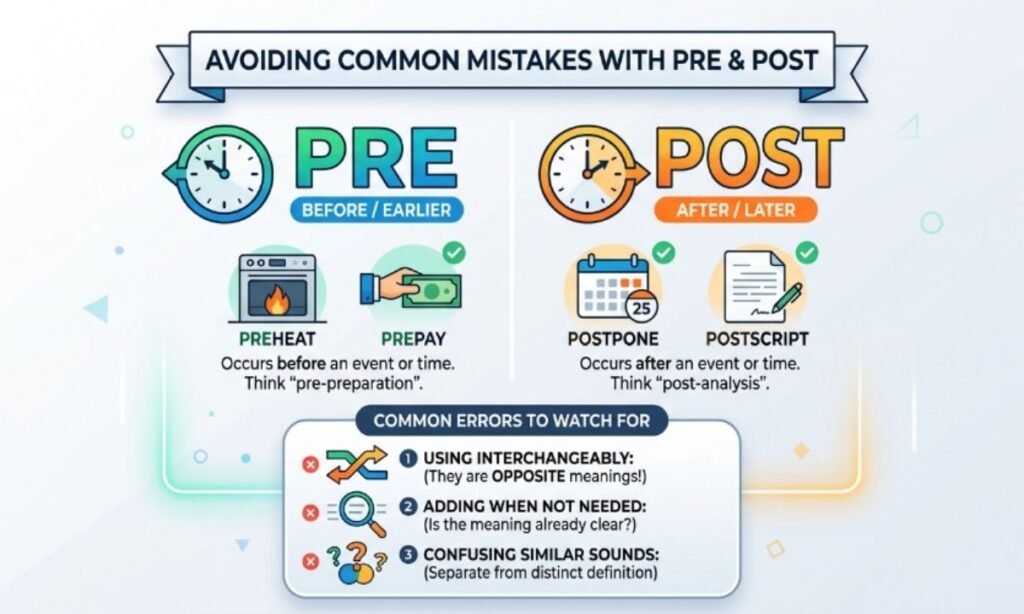
Even fluent speakers sometimes mix up Pre vs Post in fast-paced writing, so it helps to know exactly where these slip-ups tend to happen.
Mistake 1: Using Pre and Post Interchangeably
Because both prefixes attach to the same root words, it’s easy to swap them by accident — writing “post-op instructions” when you mean “pre-op instructions,” for example. Always double-check the timeline before publishing or submitting formal documents.
Mistake 2: Adding Them When Not Needed
Not every word needs a “pre” or “post” attached. Overusing these prefixes (for example, “pre-plan” instead of simply “plan”) can make writing sound cluttered and redundant.
Mistake 3: Confusing Meaning Because of Similar Sound
Some readers skim quickly and misread “pre-” as “post-” or vice versa, especially in dense technical text. Bolding or clearly separating these terms in writing reduces reader error.
Practical Tips to Improve Prefix Usage
These simple habits make it easy to master Pre vs Post in everyday writing and reading.
1. Translate the Prefix
Mentally swap “pre-” for “before” and “post-” for “after.” If the sentence still makes sense, you’ve used it correctly.
2. Break Down the Word
Separate the prefix from the root word to see the core meaning clearly — for instance, “post” + “partum” (childbirth) = after childbirth.
3. Use the Before/After Test
Ask yourself: does this word describe something happening ahead of or following the main event? That answer tells you which prefix to use.
4. Think in Terms of Timelines
Visualize a timeline with the main event in the center. Anything to the left is “pre,” and anything to the right is “post.”
5. Learn Through Real-World Examples
Studying niche examples strengthens your intuitive grasp of these prefixes in specialized contexts. Here are a few frequently searched ones:
Pre vs Post Capillary Pulmonary Hypertension
In cardiology, this distinction separates two categories of pulmonary hypertension based on where the pressure problem originates. Pre-capillary pulmonary hypertension occurs due to issues in the pulmonary arteries before blood reaches the capillaries, while post-capillary pulmonary hypertension results from elevated pressure in the left side of the heart, affecting blood after it passes through the capillaries. This distinction guides treatment decisions significantly.
Pre vs Post Synaptic Neuron
In neuroscience, a presynaptic neuron sends a signal (releasing neurotransmitters) before the message reaches the synapse gap, while a postsynaptic neuron receives that signal after it crosses the gap. This relationship is fundamental to understanding how neurons communicate.
Zoro Pre vs Post Timeskip
Among anime fans, “Zoro Pre vs Post Timeskip” refers to comparing the character Roronoa Zoro’s abilities, appearance, and strength before and after the two-year time skip in the series One Piece. Post-timeskip Zoro shows major growth in power, training, and combat mastery compared to his pre-timeskip version.
Pre vs Post Zygotic
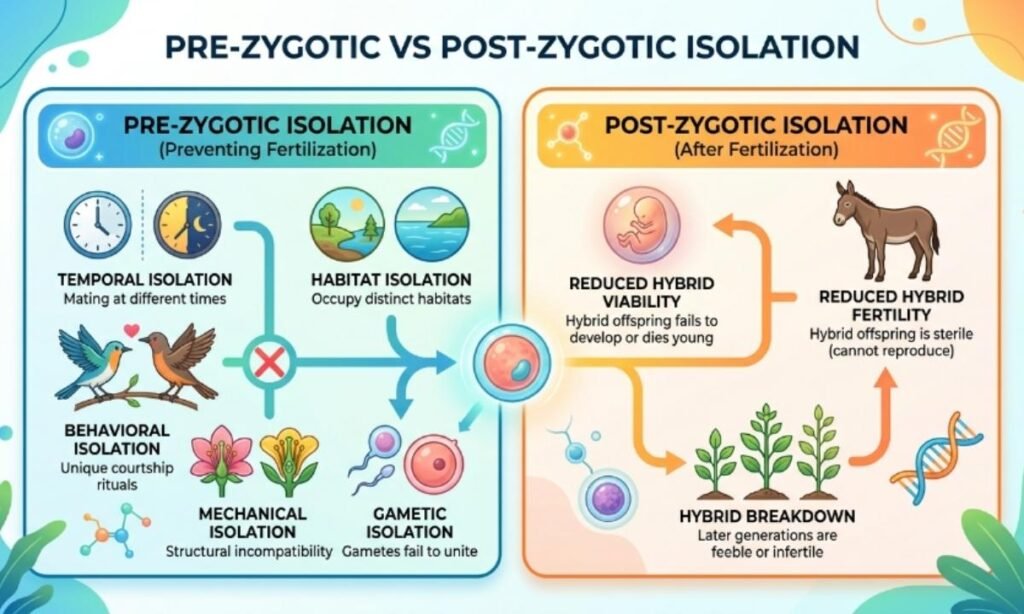
In biology, pre-zygotic barriers prevent fertilization from happening at all (such as differences in mating behavior or timing), while post-zygotic barriers occur after fertilization, often resulting in reduced viability or fertility of offspring. This concept is central to studying reproductive isolation and species formation.
Case Studies: Real Applications of Pre vs Post
Case Study 1: Marketing Launch Strategy
A software company ran a pre-launch email campaign for three weeks, building an early-access waitlist. Once the product went live, their post-launch strategy shifted to onboarding emails and customer feedback surveys. Comparing pre-launch sign-ups to post-launch retention through a simple Pre vs Post analysis gave the team clear data on what worked.
Case Study 2: Hospital Procedure
A surgical team used a pre-operative checklist to confirm patient readiness, then followed a post-operative recovery protocol that tracked vital signs every hour for the first 24 hours. This structured before-and-after approach reduced complications significantly.
Case Study 3: Academic Research
A university study measured student stress levels using a pre-exam survey and a post-exam survey. The pre-post comparison showed a measurable drop in stress after the exam period ended, supporting the researchers’ hypothesis about anticipatory anxiety.
Helpful Quotes on Language and Meaning
Linguists often note that prefixes like “pre-” and “post-” act as small but powerful “time markers” in English — they compress an entire before-and-after relationship into a single syllable. This efficiency is exactly why the Pre vs Post pairing appears so often across medicine, finance, research, and everyday conversation.
FAQs
What is the difference between pre and post?
“Pre” means before an event, while “post” means after an event. This Pre vs Post distinction applies across grammar, medicine, business, and research.
What is post vs pre?
Post refers to something occurring after a reference point, while pre refers to something occurring before it — the two are direct opposites in meaning.
Does the post be before or after?
“Post” always means after. It never refers to something happening before an event.
Is pre before or after?
“Pre” always means before. It signals preparation, anticipation, or timing ahead of the main event.
What does pre-op vs post-op mean?
Pre-op refers to the period and preparation before surgery, while post-op refers to recovery and care after surgery is completed.
What is pre-money vs post-money valuation in startups?
Pre-money valuation is a company’s worth before new investment; post-money valuation is its worth after the investment is added.
Is pre-tax or post-tax better for retirement savings?
It depends on your current versus expected future tax bracket — pre-tax contributions lower taxable income now, while post-tax (Roth) contributions grow tax-free for withdrawal later.
What is the pre-test vs post-test method in research?
It’s a study design that measures a baseline (pre-test) before an intervention and compares it to results (post-test) after the intervention to evaluate effectiveness.
Can “post” be used without “pre” in a sentence?
Yes. “Post” can stand alone as a noun or verb (like “post a letter” or “job post”) without needing “pre” as its counterpart.
Conclusion
At its heart, the Pre vs Post debate comes down to a simple timeline: pre- means before, and post- means after. Yet as this guide shows, that simple rule stretches across incredibly diverse fields — from pre-tax retirement contributions to post-operative hospital recovery, from pre-money startup valuations to post-synaptic neurons firing in the brain. Once you internalize the before/after test, you’ll never second-guess these prefixes again. Whenever you’re unsure which one to use, just ask: is this happening before the event, or after it? That single question resolves nearly every question you’ll ever encounter.

Hi, I’m Alex Carter, a passionate content creator and language enthusiast dedicated to exploring the true meanings behind words, phrases, and modern slang. With over 5 years of experience in content research and digital publishing, I specialize in breaking down complex terms into simple explanations. I focus on delivering well-researched, up-to-date, and SEO-optimized content that answers real user queries.