

ISTG meaning in chat is simple: it stands for “I swear to God,” a fast way to tell someone you are completely serious. You will spot it in group chats, comment sections, and late-night DMs, usually when someone is annoyed, amazed, or just very sure about something.
This guide explains the ISTG meaning in chat, where the slang came from, and how boys, girls, and Gen Z use it differently. You will also find real examples, reply ideas, similar slang terms, and a quick look at how it travels across cultures. By the end, you will know exactly when to use it and when to skip it.
What Does ISTG Mean in Chat? A Quick Explanation
ISTG means “I swear to God.” People type it to add weight to a statement, whether they are frustrated, excited, or joking. It works like a verbal underline: the sentence says what you think, and ISTG tells the reader how strongly you think it.
Here is the quick version:
- Full form: I swear to God
- Type: Internet slang and text abbreviation
- Tone: Emphatic, usually casual
- Best for: Friends, social media, and informal messages
- Avoid in: Formal emails, job applications, and client messages
Example: “ISTG if this bus is late again, I’m walking.”
A simple way to remember it: ISTG means “I’m not exaggerating, or at least it feels that way.” Even when the claim is clearly dramatic, such as swearing your cat is plotting against you, readers understand the wink behind it.
The ISTG meaning in chat rarely changes, but the feeling behind it does. That is why reading the full message matters more than reading the abbreviation alone.
Think of it as a signal, not a sentence. On its own, ISTG tells you the writer feels strongly. The words around it explain what that strong feeling actually is.
Common Emotions and Meanings Expressed by ISTG
ISTG is flexible. The feeling behind it depends on the sentence around it, the emojis used, and who is typing.
| Emotion | What ISTG Signals | Example |
| Frustration | I am at my limit | “ISTG, you never reply on time.” |
| Excitement | I can’t believe it | “ISTG that concert was unreal.” |
| Honesty | I am telling the truth | “ISTG I didn’t touch your charger.” |
| Warning | I mean what I say | “ISTG I’ll leave without you.” |
| Humor | Playful exaggeration | “ISTG my cat plans my mornings.” |
| Disbelief | This is hard to accept | “ISTG she did that in front of everyone.” |
ISTG Full Meaning
The ISTG full meaning is “I swear to God.” Each letter stands for one word: I, S(wear), T(o), G(od). It is a shortened oath, used to stress sincerity.
You may also see related spellings such as STG, which drops the “I” but means the same thing. Another rare form is IS2G, which swaps “to” for the number 2, a common texting trick.
Despite the religious wording, most people use it as a casual intensifier rather than a true vow. Knowing the full meaning helps you understand why the ISTG meaning in chat carries so much emotional weight in so few letters.
Spelling matters less than context. Whether someone types ISTG, istg, or STG, readers almost always get the same message: “I really mean this.”
The Origin and Background of ISTG
ISTG grew out of early chat rooms, instant messaging, and text culture. Typing was slow and character limits were tight, so people shortened common phrases. “I swear to God” was already a popular spoken emphasis, so it was a natural fit.
Many of today’s popular abbreviations followed the same path. LOL, OMG, and BRB all began as shortcuts in early online chats, and ISTG joined them because it carried emotion that plain words could not. The spoken habit came first, and the typed version simply copied it.
As social media took off, the abbreviation spread to Twitter, Tumblr, Instagram, and later TikTok. Short, emotional phrases travel fast online, and ISTG gave people a quick way to sound serious without writing a long sentence.
Over the years, three things kept it alive:
- Speed: Four letters beat a full phrase.
- Emotion: It adds feeling to flat text.
- Familiarity: People already said it out loud.
Today it is part of everyday digital language. The ISTG meaning in chat has barely changed, but its tone has become lighter and more playful over time.
What does “ISTG” mean in Gen Z slang?
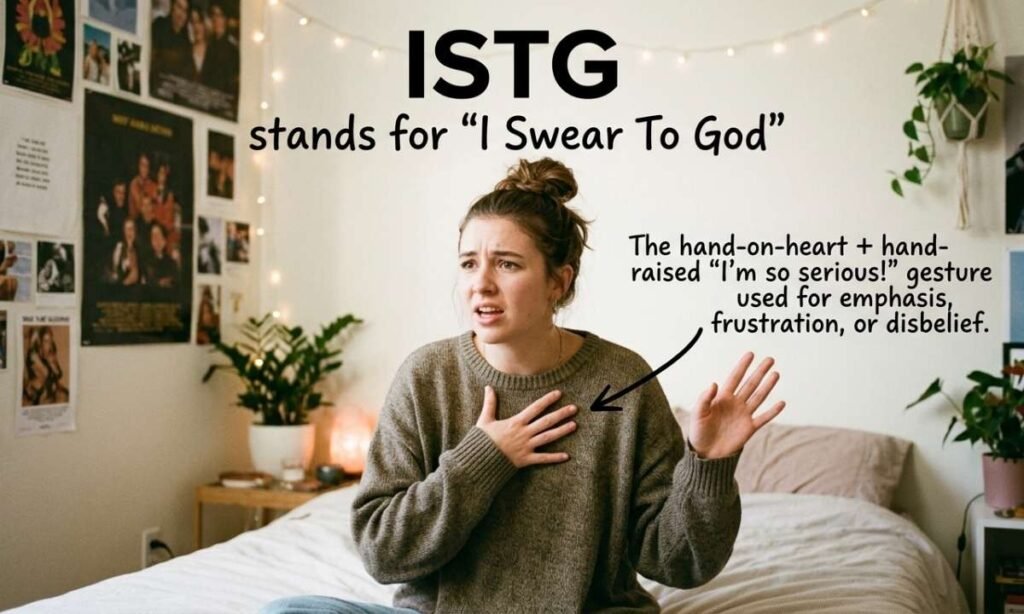
In Gen Z slang, ISTG often works as pure emphasis. It can show real irritation, but it is just as likely to be a joke or a dramatic reaction.
Common Gen Z patterns include:
- Dramatic complaints: “ISTG my alarm hates me.”
- Fan reactions: “ISTG this song is on repeat.”
- Friendly threats: “ISTG I’ll steal your fries.”
Gen Z users also stretch it into running commentary: “ISTG this teacher gives homework on Fridays on purpose.” Nobody expects a real promise. The phrase simply adds drama and personality to the sentence.
Pair it with “no cap,” “fr,” or “deadass,” and the message sounds even more emphatic. For many young people, the ISTG meaning in chat is less about swearing and more about sounding expressive.
ISTG Meaning from a Girl
When a girl uses ISTG, the meaning usually depends on tone and relationship. With close friends, it often signals playful exaggeration or excitement, like “ISTG I screamed when I saw that outfit.”
In a heated moment, it can show frustration or a firm boundary. Because tone is hard to read in text, emojis and punctuation do a lot of the work. A laughing emoji softens it. A period at the end makes it feel firmer.
Common girl-to-friend examples include “ISTG you look amazing,” “ISTG I can’t with this traffic,” and “ISTG I told you so.” Each one sounds different, yet the abbreviation stays the same.
If a girl you are texting uses ISTG, look at how she usually writes. The ISTG meaning in chat from a girl is often warm and dramatic, not hostile.
ISTG Meaning from a Boy
From a boy, ISTG usually carries the same core meaning: “I’m serious.” Among friends it often appears in banter, gaming chats, and sports talk, such as “ISTG he was offside.”
Typical examples include “ISTG that was a foul,” “ISTG I’ll beat you next round,” and “ISTG this lag is killing me.”
In arguments, it can sound blunt or defensive. In friendly chats, it is mostly casual and can even be a compliment, like “ISTG you’re the best teammate.”
As with any ISTG meaning in chat, the sender’s usual style tells you more than the letters themselves. A boy who jokes a lot is probably joking again.
The same logic applies to every sender. Gender does not change the phrase. Personality, mood, and the relationship between the two people do.
ISTG Meaning in Chat in English
In English-language chats, ISTG is almost always read as “I swear to God.” It is typed in lowercase or capitals, with or without punctuation, and usually sits at the start or end of a sentence.
- Start: “ISTG you’re going to be late.”
- End: “I forgot my keys again, ISTG.”
- Standalone: “ISTG.” (a one-word reaction)
- Mid-sentence: “I’m ISTG about to lose it.”
Capital letters tend to feel louder, while lowercase “istg” feels more relaxed.
Punctuation also shifts the mood. An exclamation mark adds energy, a question mark adds disbelief, and a full stop adds firmness. This flexibility is why the ISTG meaning in chat feels natural in so many situations.
Real-Life Examples of ISTG in Everyday Conversations

Seeing ISTG in context makes it easier to understand. Here is how it appears on different platforms.
ISTG in WhatsApp Chats
On WhatsApp, ISTG often appears in family and friend groups, usually with voice-note energy: “ISTG I told you to call me back 😅.”
It works well for quick, emotional replies when you do not want to type a long message. In group chats, it also helps stress which message really needs an answer.
ISTG in Instagram Direct Messages
In Instagram DMs, ISTG often sits beside memes and reels: “ISTG this reel is literally us.”
It adds humor and personality, which suits the casual feel of the platform. Here, the ISTG meaning in chat is almost always playful.
ISTG in Text Message Conversations
In plain texts, ISTG usually carries more seriousness because there is less visual context: “ISTG I’m outside, open the door.”
Here, the ISTG meaning in chat leans toward urgency or irritation. A short reply that confirms you understood usually calms things down.
ISTG in TikTok Comments
On TikTok, ISTG appears in comment sections as an instant reaction: “ISTG I watched this ten times.”
Creators and viewers use it to show strong feelings in just a few characters. The ISTG meaning in chat and in comments is the same, but comments tend to be more dramatic.
The Emotional and Psychological Significance of ISTG
Slang often exists because people want to sound more human in text. A flat sentence has no voice, so people add short phrases that carry feeling. ISTG fills that gap well.
Psychologists who study online communication often note that text lacks facial expressions and tone of voice. People fill that gap with emojis, capital letters, and short emphasis phrases. ISTG is one of the quickest tools for that job.
Understanding the ISTG meaning in chat means understanding the feelings it carries, not only the words it spells out.
How ISTG Communicates Strong Emotions
ISTG intensifies whatever follows it. Anger sounds sharper, joy sounds bigger, and disbelief sounds louder.
It acts like raised volume in a written conversation. Without it, “I’m tired of waiting” is a statement. With it, “ISTG I’m tired of waiting” is a feeling.
How ISTG Creates a Sense of Honesty and Authenticity
Because it echoes a spoken oath, ISTG makes a message feel sincere. Readers tend to take the statement as the writer’s honest feeling.
That is why friends use it when they want to be believed, even in small matters. It signals, “This is not a joke,” or sometimes, “This is a joke, but I really mean the feeling.”
ISTG as a Form of Fast and Expressive Communication
Typing four letters is faster than typing a full phrase. It is also more expressive than a plain sentence.
That mix of speed and emotion explains why the ISTG meaning in chat keeps its popularity. People can react in seconds and still sound human.
How ISTG Is Used in Different Situations
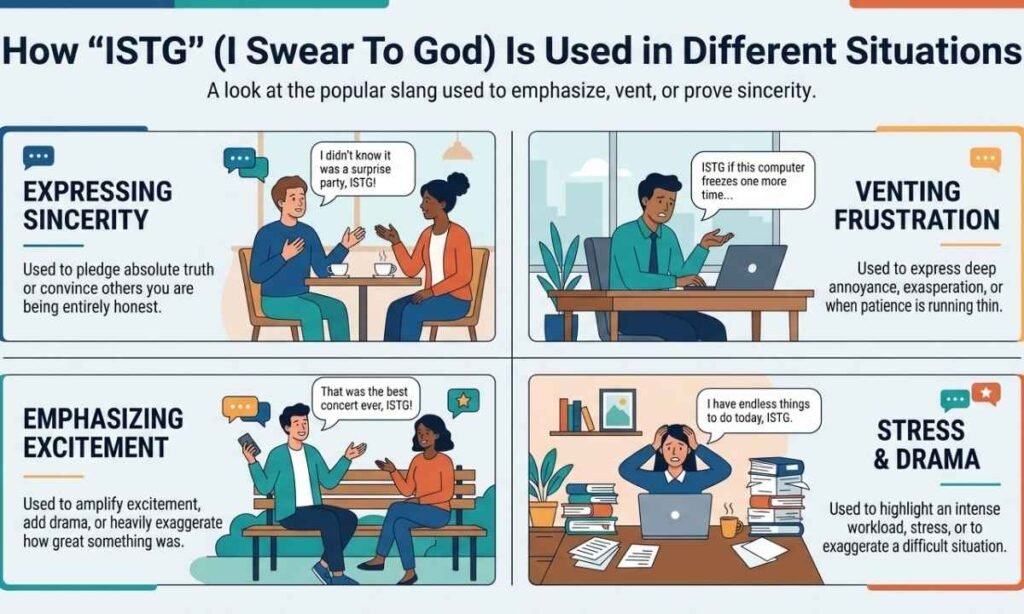
The same abbreviation can sound funny, serious, or inappropriate. Context decides everything, and a good reader checks the platform, the person, and the mood before reacting.
Before you use ISTG, ask yourself three quick questions:
- Who am I talking to? Friends can handle slang, managers may not.
- What is the mood? Jokes and arguments need different tones.
- Is it needed? If the message is already clear, skip the extra emphasis.
Using ISTG Across Social Media Platforms
- WhatsApp and Messenger: Friendly, conversational
- Instagram and Snapchat: Casual, meme-style
- TikTok and X: Reactions and commentary
- Discord and gaming chats: Banter and frustration
Each platform shapes how strongly ISTG lands. The ISTG meaning in chat stays the same everywhere, but the tone shifts with the audience.
ISTG Between Friends and Romantic Partners
Between friends, ISTG is usually playful. Between partners, it can be affectionate (“ISTG I miss you”) or serious (“ISTG we need to talk”).
Watch the rest of the message and the emojis for clues. In close relationships, a calm reply works better than a defensive one.
If you are unsure what your partner means, ask directly. A short “What do you mean?” prevents small misunderstandings from growing.
ISTG in Professional and Workplace Communication
Avoid ISTG in formal emails, reports, and client messages. It sounds informal and may confuse older colleagues.
In relaxed team chats, a light use may be fine, but only if your workplace culture allows it. When in doubt, write “I promise” or “I am certain” instead.
Other safe workplace options include “I assure you,” “I am confident,” and “To be clear.” They carry the same emphasis without the casual tone.
Understanding the Difference Between Casual and Serious Uses of ISTG
| Casual Use | Serious Use |
| Jokes and exaggeration | Warnings or firm statements |
| Emojis and laughter | Short, blunt sentences |
| Friends and group chats | Arguments or tense moments |
| “ISTG this pizza is perfect” | “ISTG, don’t do that again.” |
A good rule: the more emojis and exclamation marks, the lighter the ISTG meaning in chat is likely to be.
Common Misinterpretations of ISTG and What They Mean
Slang is easy to misread. These are the most common mix-ups when people interpret the ISTG meaning in chat.
Most errors happen because text hides tone. A typo, a missing emoji, or a short reply can make a friendly message look harsh.
Mistake 1: Assuming ISTG Always Expresses Anger
ISTG can show anger, but it often expresses joy, shock, or humor. A message like “ISTG that was the best day” is pure happiness.
Always check the surrounding words before assuming the worst.
Mistake 2: Assuming ISTG Always Has a Literal Religious Meaning
Most users are not making a religious statement. The phrase is a habit of speech, not a spiritual claim.
If someone feels uncomfortable with religious wording, they can simply use “I promise” instead.
Mistake 3: Using ISTG in Formal or Professional Messages
Formal messages call for full sentences. Writing ISTG in a work email can look careless or unprofessional.
Save it for friends, group chats, and social media where slang is expected.
A good habit is to read your message once before sending. If it would sound odd spoken aloud in a meeting, rewrite it.
Mistake 4: Overlooking the Conversation’s Tone When Interpreting ISTG
The same words can feel warm or harsh. Read the whole thread, not just the abbreviation.
Past messages, emojis, and typing style all reveal the real ISTG meaning in chat.
ISTG vs. Other Similar Slang Terms
ISTG sits among many emphasis phrases. Here is how it compares.
| Term | Meaning | Tone |
| ISTG | I swear to God | Emphatic, emotional |
| ONG | On God | Confident, sincere |
| FR | For real | Casual agreement |
| NGL | Not gonna lie | Honest, soft |
| TBH | To be honest | Mild, polite |
| No cap | No lie | Playful, trendy |
Choose ISTG when emotion is high, ONG when you want a confident tone, and TBH or NGL when you want to share an opinion gently. FR works best for quick agreement, and no cap fits playful, trendy captions.
The Key Difference to Remember
ISTG adds emotional force, while terms like TBH and NGL soften a statement. Use ISTG when you want impact, not when you want to sound gentle.
10 ISTG Variations and Related Slang Expressions
These expressions often appear next to ISTG in modern chats. Learning them makes the ISTG meaning in chat easier to place within the wider world of internet slang.
1. ISTG: The Original Abbreviation
The classic form. It expresses sincerity, irritation, or excitement in four letters, and it remains the most recognized version.
2. I SWTG: A Related Expression
A less common spelling of “I swear to God.” It means the same thing but appears far less often, so most readers may need a second to decode it.
3. ONG: A Similar Way to Emphasize Truth
“On God” is a popular alternative that stresses honesty. It often appears in captions and comments, usually after a bold claim.
4. IYKYK: A Slang Term for Shared Understanding
“If you know, you know” refers to an inside joke or shared experience. It does not stress truth, but it builds connection between people who understand the reference.
5. FR: Short for “For Real”
A quick way to agree or confirm something. “FR, that was amazing.” It is lighter than ISTG and rarely sounds angry.
6. FRFR: An Emphatic Way to Say “For Real”
The doubled version adds extra emphasis. It sounds more passionate than a single FR and is common in comment sections.
7. NGL: Short for “Not Gonna Lie”
NGL introduces an honest opinion, often a slightly awkward one. “NGL, I didn’t love the ending.”
8. TBH: Short for “To Be Honest”
A gentle way to share a truthful thought. It is more polite than ISTG and fits more situations.
9. NO CAP: A Phrase Meaning “No Lie”
“Cap” means a lie, so “no cap” means you are telling the truth. It is popular with Gen Z and appears often in captions.
10. DEADASS: Slang for Being Completely Serious
Strongly serious and often used in American slang. “Deadass, I’m not joking.” It is closer to ISTG in intensity than most other terms on this list.
Quick tip: Do not stack too many slang terms in one message. One well-placed phrase feels natural, while five in a row can look forced.
How to Reply When Someone Uses ISTG in a Message
Your reply should match the tone. Here are four simple options, depending on the mood.
Before you reply, follow this simple order:
- Read the full message once.
- Notice the tone and emojis.
- Decide whether to joke, reassure, or clarify.
- Keep your answer short.
Casual Responses to ISTG
- “Okay, okay, I hear you 😅”
- “Fair enough!”
- “Got it, I’ll fix it.”
- “Understood, thanks for telling me.”
Funny Comebacks to ISTG
- “God has been informed 😂”
- “That sounds like a formal oath.”
- “Noted, your honor.”
- “Should I be scared or impressed?”
Mature and Self-Assured Responses to ISTG
- “I understand why you feel that way.”
- “Let’s talk about it calmly.”
- “Thanks for being clear with me.”
- “I hear you, and I’ll do better.”
Private and Respectful Ways to Respond to ISTG
If the message feels heated, move the conversation to a private chat or a call. A short, calm reply keeps things respectful: “Can we talk about this privately?”
Taking the ISTG meaning in chat seriously when someone is upset shows maturity and care.
ISTG Usage Across Different Regions and Cultures
Slang changes by place. The ISTG meaning in chat stays the same, but attitudes toward it differ from one culture to another.
How ISTG Is Used in Western Culture
In the US, UK, and Canada, ISTG is common among teens and young adults. It is mostly informal and often humorous.
It appears in texts, captions, and gaming chats, and most people read it as casual emphasis.
ISTG Usage in Asian Culture
In parts of Asia, English slang spreads through social media and gaming. ISTG appears in English-language chats, especially among younger users, and is usually read as casual emphasis.
Many young people learn it from videos, streamers, and international friends.
Because English slang often arrives through entertainment, the meaning usually stays close to the original. Local language habits may add small twists, but the idea of strong sincerity remains.
Understanding ISTG in Middle Eastern Culture
Phrases that mention God are often treated with extra respect in many communities. Some people avoid using ISTG casually, while others see it as harmless internet language.
Respect local attitudes and the person you are chatting with. If you are unsure, choose a neutral phrase like “I promise.”
How ISTG Is Used Across the Global Internet
Online, ISTG has become a shared shorthand. Gamers, creators, and students all recognize it. Its simple structure makes it easy to understand across languages.
Memes, short videos, and streaming culture keep carrying it to new audiences every year.
That is why the ISTG meaning in chat feels familiar even to people who speak English as a second language.
What should I reply to ISTG?
Match the tone. If it is playful, answer with humor. If it is serious, respond calmly and clearly. When unsure, ask a friendly question like “Are you okay?” to check the mood.
A quick formula that works: acknowledge the feeling, answer the point, and keep it short.
| Situation | Suggested Reply |
| Friend is joking | “Haha, noted 😂” |
| Friend is annoyed | “Sorry, I’ll fix it.” |
| Partner is upset | “I hear you. Can we talk?” |
| Coworker uses slang | “Got it, thanks.” |
Frequently Asked Questions
What does ISTG meaning in chat stand for?
ISTG means “I swear to God,” used to show strong sincerity or emotion.
Is ISTG rude?
Not usually, but it can sound blunt in arguments or formal settings.
What is the full form of ISTG?
The full form of ISTG is “I swear to God.”
Is ISTG the same as STG?
Yes, STG is a shorter version with the same meaning.
Can I use ISTG at work?
It is best to avoid it in formal or professional messages.
How do I reply to ISTG?
Match the tone with a casual, funny, or calm reply.
Is ISTG a religious phrase?
It uses religious wording, but most people use it as casual slang.
What is the difference between ISTG and ONG?
ISTG expresses swearing to God, while ONG means “on God” and sounds a bit more confident.
Where did ISTG come from?
It grew out of early chat rooms and texting, where short phrases saved time.
Conclusion
Understanding ISTG meaning in chat helps you read messages more clearly and reply with confidence. It is a short, expressive phrase that adds honesty and emotion to digital conversations.
Use it with friends, avoid it in formal settings, and always check the tone before replying. Once you know the ISTG meaning in chat, you will spot it everywhere online.

Hi, I’m Alex Carter, a passionate content creator and language enthusiast dedicated to exploring the true meanings behind words, phrases, and modern slang. With over 5 years of experience in content research and digital publishing, I specialize in breaking down complex terms into simple explanations. I focus on delivering well-researched, up-to-date, and SEO-optimized content that answers real user queries.