

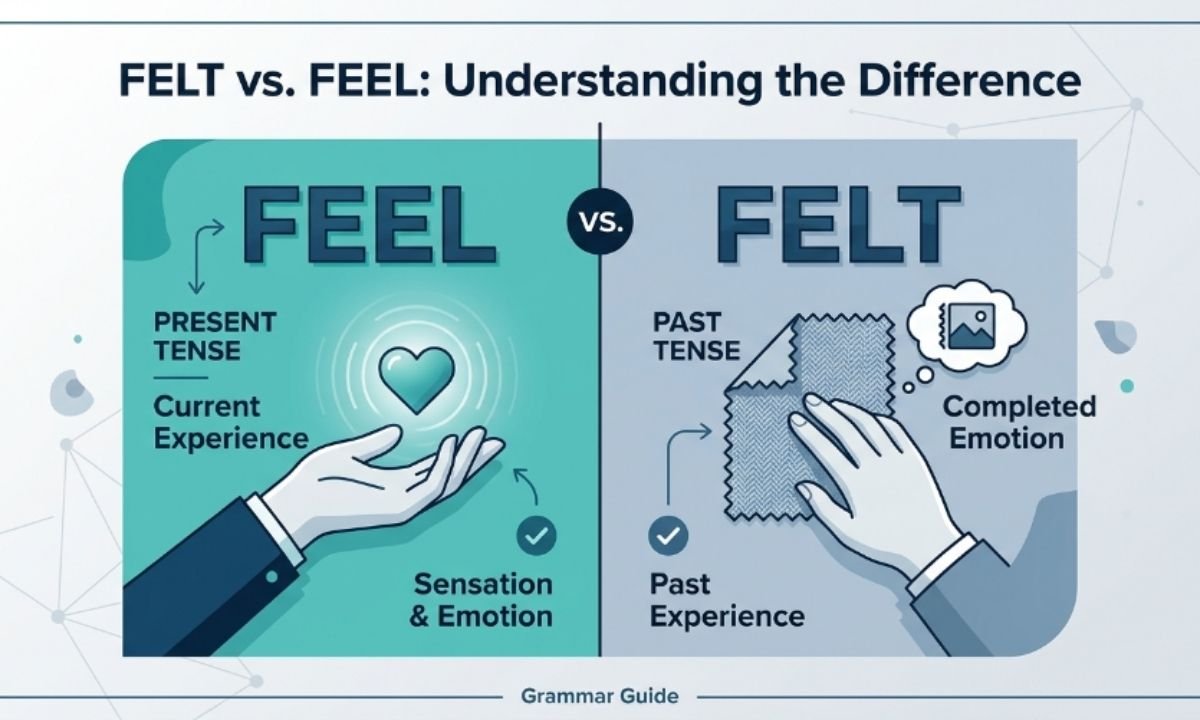
Felt vs Feel trips up learners and native speakers alike, yet the rule is simple: “feel” describes the present, and “felt” describes the past. Both words come from the same verb. “Felt” is its past tense and past participle, so you cannot swap them when timing matters. To add to the confusion, “felt” is also a noun for a soft fabric.
In this guide, you will learn what each word means, how the Felt vs Feel choice changes in questions, negatives, and “that” clauses, and how to use both in formal and casual English.
You will also get examples, short exercises, common expressions, and memory tricks so you can pick the right word every time.
What Does Feel Mean?
Simple Meaning
“Feel” is a verb. It means to sense something by touch or to experience an emotion or physical state. It is the base form and the present tense.
Examples
- I feel happy today.
- She feels the cold wind on her face.
- Do you feel okay?
- I feel that this plan will work.
What Does Felt Mean?
Simple Meaning
“Felt” is the past tense and past participle of “feel.” It describes a feeling or sensation that already happened.
Examples
- I felt nervous before the exam.
- He felt a sharp pain in his knee.
- We have felt this way for weeks.
- She had never felt so proud.
Key Difference Between Felt and Feel
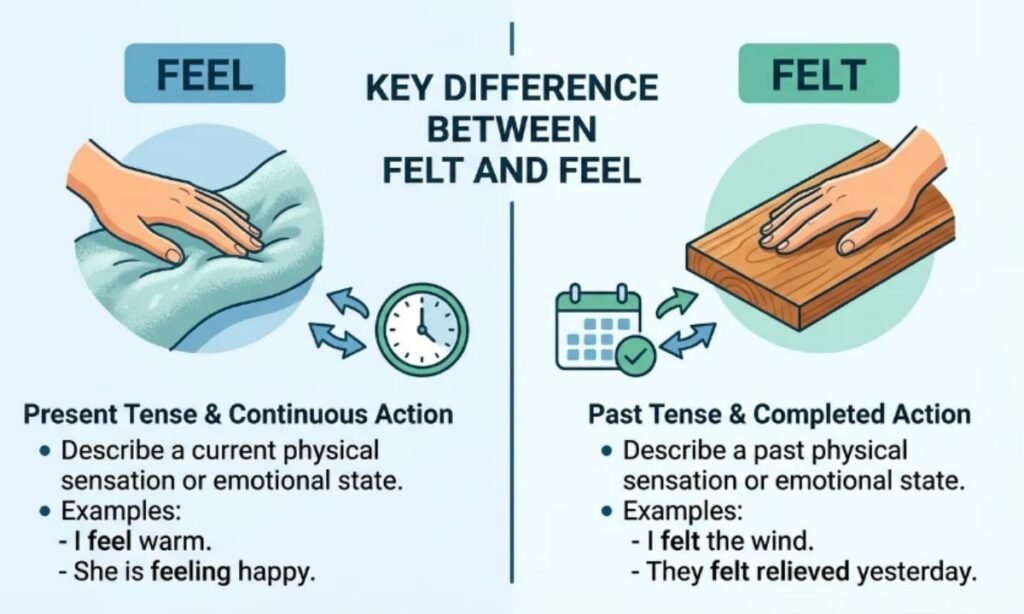
The Felt vs Feel difference comes down to time. One word points to now, and the other points to before.
| Form | Type | Time | Example |
| feel | Base / present | Now, habits, facts | I feel calm. |
| feels | He / she / it | Now | She feels calm. |
| felt | Past simple | Before now | I felt calm. |
| felt | Past participle | Perfect tenses | I have felt calm. |
| feeling | -ing form | Ongoing | I am feeling calm. |
Simple Rule
Use feel for the present. Use felt for the past. “Feeled” is not a word, because “feel” is an irregular verb.
When to Use Feel
Use “feel” for:
- Current emotions or sensations
- Habits and general truths
- Base-form spots after do, does, did, will, can, must, or to
Examples:
- I feel excited about the trip.
- Wool feels warm.
- You will feel better soon.
When to Use Felt
Use “felt” for:
- Finished actions in the past
- Perfect tenses with have, has, or had
- Past emotions, beliefs, or impressions
Examples:
- I felt excited about the trip.
- The room felt warm.
- She has felt better since Monday.
Is “I Feel It” or “I Felt It” Correct?
Both are correct. The Felt vs Feel choice depends on timing. “I feel it” means it is happening now. “I felt it” means it already happened.
Compare these:
- “Did you feel that?” (asking about something that just happened)
- “Yes, I felt it too.” (answering in the past)
Felt vs Feel Exercises
Fill in each blank with feel or felt.
- Right now, I am ___ excited.
- Yesterday, she ___ tired after work.
- Did you ___ the earthquake?
- We have ___ this way before.
- He doesn’t ___ well today.
- I ___ cold last night.
Answers: 1. feel, 2. felt, 3. feel, 4. felt, 5. feel, 6. felt.
I Feel or Felt Bad
Both work, and timing decides. “I feel bad about it” describes now. “I felt bad about it” describes them.
Use the adjective “bad” after this verb. “Feel bad” is the standard choice. “Feel badly” is debated, so stick with “bad” in formal writing. “Feel bad for someone” means you sympathize with them.
Felt vs Feel in Sentences
Here are both words in common sentence types:
- Statement: I feel safe here. / I felt safe there.
- Future: You will feel better tomorrow.
- Perfect: They have felt lonely lately.
- Third person: He feels nervous. / He felt nervous.
- With “like”: I feel like sleeping. / I felt like sleeping.
Felt vs Feel Examples
| Context | Feel (present) | Felt (past) |
| Emotion | I feel proud. | I felt proud. |
| Touch | The fabric feels soft. | The fabric felt soft. |
| Opinion | I feel it’s unfair. | I felt it was unfair. |
| Health | She feels dizzy. | She felt dizzy. |
| Intuition | I feel something is wrong. | I felt something was wrong. |
Felt vs Feel Grammar
Grammar Rules for Felt and Feel
- The forms are feel → felt → felt.
- Add -s for he, she, and it: “feels.”
- After do, did, will, can, must, and to, use the base form “feel.”
- After have, has, and had, use “felt.”
- Follow “feel” with an adjective, not an adverb: “I feel happy,” not “I feel happily.”
Felt vs Feel in Questions
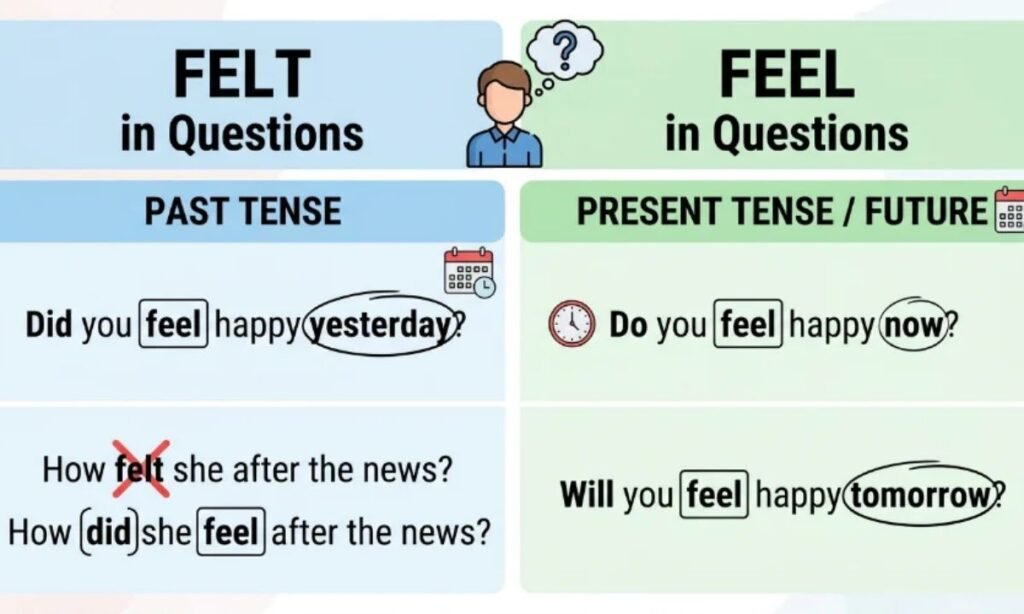
- Present: Do you feel cold?
- Past: Did you feel cold? (not “Did you felt”)
- Perfect: Have you ever felt this way?
“Did” already shows past tense, so the main verb goes back to “feel.”
Felt vs Feel in Negative Sentences
- I don’t feel well.
- She didn’t feel any pain. (not “didn’t felt”)
- I have never felt so lost.
- I felt nothing. (no helper verb, so “felt”)
Felt vs Feel in Continuous Tense
“Feel” often works as a state verb, so simple forms are common: “I feel tired.” Use “feeling” for changing, temporary states.
- I’m feeling better today.
- She was feeling anxious.
“Felt” never appears in continuous tenses.
Felt vs Feel in Formal and Informal English
Formal
Reports and business emails use both words in a measured way.
- We feel that the proposal is sound.
- The committee felt that more time was needed.
For a firmer tone, “believe” or “concluded” can replace “feel.”
Informal
Casual speech is looser.
- I feel you.
- I’m feeling it.
- Online, people sometimes reply “felt” to say “I relate.”
Felt vs Feel in Writing and Speaking
In writing, keep your tenses consistent. Don’t jump from “felt” to “feel” inside one past-tense paragraph. In speaking, the words sound different: feel rhymes with “meal,” and felt rhymes with “belt.”
People sometimes slide into the present while telling a story (“So I feel really nervous, and…”).
Felt vs Feel with “That” Clauses
“Feel that” or “felt that” introduces an opinion. The main verb sets the time, and the second verb usually follows it.
- I feel that it’s wrong.
- She felt that it was wrong.
- I felt it was wrong. (you can drop “that”)
Felt vs Feel in Real-Life Conversations
- “How do you feel?” — “I feel great.”
- “How did you feel after the interview?” — “I felt relieved.”
- “Did you feel that?” — “Yes, the floor shook.”
Felt vs Feel in Emotional Expression
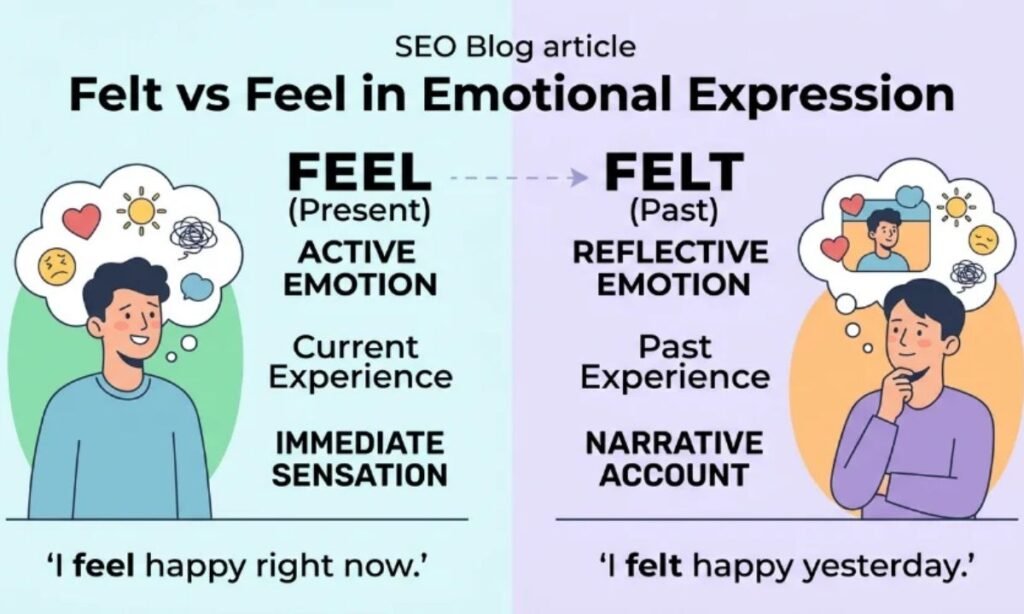
Use “feel” for what you’re going through now: “I feel overwhelmed.” Use “felt” when you look back: “I felt hurt when you left.”
A simple formula helps:
- I feel ___ when ___.
- I felt ___ when ___.
Felt vs Feel in Storytelling
Most stories use the past tense, so “felt” carries the narration: “She felt her heart race.” “Feel” shows up in dialogue or in present-tense stories. Pick one tense and stay in it.
Why Felt vs Feel Is Important
- It shows clear timing in your message.
- It prevents errors like “feeled” and “did you felt.”
- It keeps emails, essays, and grammar tests sounding polished.
- It helps others understand when something happened.
Examples in Daily Life
Present
- I feel hungry, so let’s eat.
- The room feels warm.
- I feel like walking today.
Past
- I felt sleepy after lunch.
- She felt relieved when the bus arrived.
- We felt the ground shake.
Similar Words to Feel
| Word | Meaning | Example |
| sense | Become aware of | I sense a change. |
| perceive | Notice through the senses | She perceives danger. |
| experience | Go through | He experiences joy. |
| notice | Become aware | I notice the cold. |
| touch | Feel by contact | Touch the fabric. |
Felt as a Noun (Different Meaning)
“Felt” is also a noun. It means a fabric made by pressing wool or other fibers together. Think of a felt hat or a felt-tip pen. This is the one case where Felt vs Feel has nothing to do with tense.
There is even a verb “to felt,” meaning to make fabric this way. Its past tense is “felted.” Context tells you which “felt” you’re reading.
Tips to Remember Felt vs Feel
- Now = feel. Then = felt. Let the “t” remind you of “then.”
- Use time clues. Yesterday, last week, and ago I called for “felt.” Now, today, we usually call for “feel.”
- Match similar verbs. Keep → kept, sleep → slept, feel → felt. They follow the same pattern.
- Check the helper verb. After did or will, use “feel.” After have or had, use “felt.”
- Write three sentences a day. Use one present and two past forms.
Common Expressions with Feel and Felt
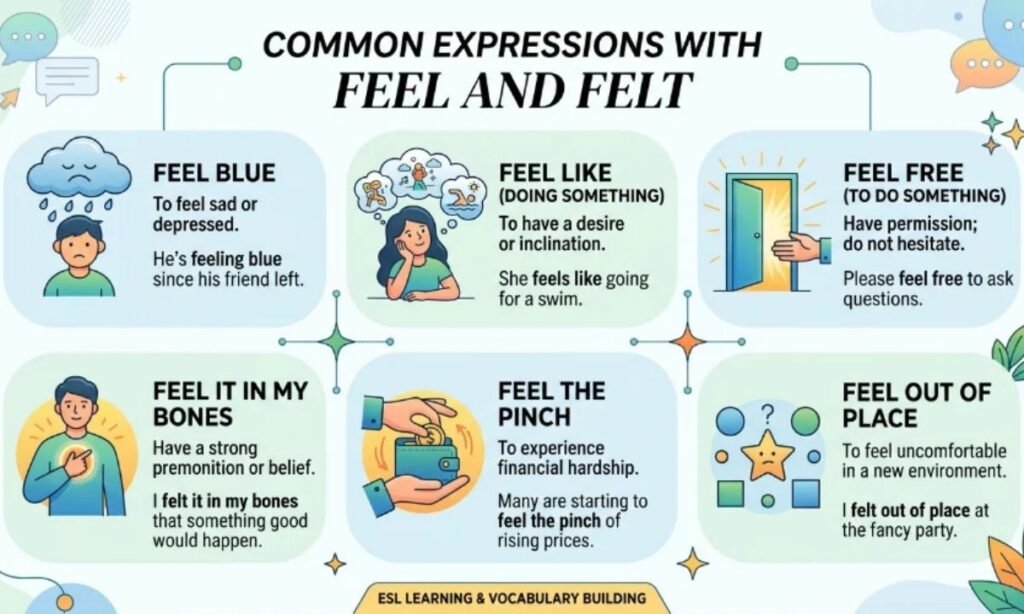
Feel
- Feel free to ask.
- Feel like a new person.
- Feel at home.
- Feel under the weather.
- Feel out of place.
Felt
- Felt like crying.
- Felt at home right away.
- Felt the pressure.
- Felt under the weather.
- Felt out of place.
FAQs
What Is the Difference Between Felt and Feel?
“Feel” is the present tense. “Felt” is the past tense and past participle.
Is “Feeled” a Word?
No. “Feel” is irregular, so the past tense is “felt.”
Is It “I Feel” or “I Felt”?
Use “I feel” for now and “I felt” for the past.
Can You Say “Did You Felt”?
No. After “did,” use the base form: “Did you feel?”
Is “Feel Badly” Correct?
“Feel bad” is the standard choice. “Feel badly” is debated, so avoid it in formal writing.
Is “Felt” the Past Participle of Feel?
Yes. The forms are feel, felt, felt.
What Does Felt Mean as a Noun?
It means a fabric made from pressed wool or other fibers.
Can Feel Be Used in the Continuous Tense?
Yes. Use “feeling” for temporary states, as in “I’m feeling better.”
What Is the Difference Between Feel and Feels?
“Feels” goes with he, she, and it in the present tense. “Feel” goes with I, you, we, and they.
Conclusion
Felt vs Feel comes down to one idea: timing. Use “feel” for what is true now, for habits, and after helper verbs like do, did, and will. Use “felt” for finished actions, past emotions, and perfect tenses with have, has, and had.
Remember that “feeled” is never correct, because “feel” is an irregular verb (feel → felt → felt). Keep in mind, too, that “felt” can be a noun for fabric, so let the context guide you.
Now put this Felt vs Feel guide to work. Redo the exercises, write a few sentences each day about how you feel and how you felt, and check the helper verb before you choose. A little daily practice makes the right form automatic in emails, essays, and everyday conversation.

Hi, I’m Alex Carter, a passionate content creator and language enthusiast dedicated to exploring the true meanings behind words, phrases, and modern slang. With over 5 years of experience in content research and digital publishing, I specialize in breaking down complex terms into simple explanations. I focus on delivering well-researched, up-to-date, and SEO-optimized content that answers real user queries.