

IWK meaning in text is simple: it stands for “I was kidding.” People type it right after a joke, a tease, or an over-the-top comment to show they were not serious. If you just got a message ending in IWK and wondered whether to laugh or worry, you are in the right place.
In this guide, you will learn what IWK means, where it came from, how boys, girls, and Gen Z use it, and how to reply. You will also see real examples, short dialogues, common mistakes, and answers to the questions people search for most.
What Does IWK Mean in Text? A Simple Definition
IWK means “I was kidding” in text. People send it after a joke, a tease, or an exaggerated statement to show they were not serious.
It softens the tone, clears up confusion, and tells the reader to relax. It is informal slang, so it fits friendly chats better than formal messages.
IWK Stands for “I Was Kidding”
IWK is an initialism. Each letter stands for one word: I Was Kidding. It looks back at something you just said, which is why it almost always appears at the end of a message or as a quick follow-up.
The past tense matters. “I was kidding” tells the reader that the earlier statement was a joke, even if it sounded real for a second.
IWK Meaning in Simple Terms
Think of IWK as a verbal wink. When you cannot use your face or tone of voice, a few letters can do the same job.
Without it, a sarcastic line can sound rude or serious. With it, the other person knows the mood is light.
A Simple Example of IWK in a Message
Person A: I’m never speaking to you again after you ate my fries.
Person A: IWK
Person B: Phew. I’ll buy you a new batch.
The first line sounds harsh. The second line fixes the tone right away.
What is the full form of IWK?
The full form of IWK in texting is “I was kidding.” Some people write the letters in lowercase (iwk) or add punctuation, but the meaning stays the same.
What Are the Other Possible Meanings of IWK?
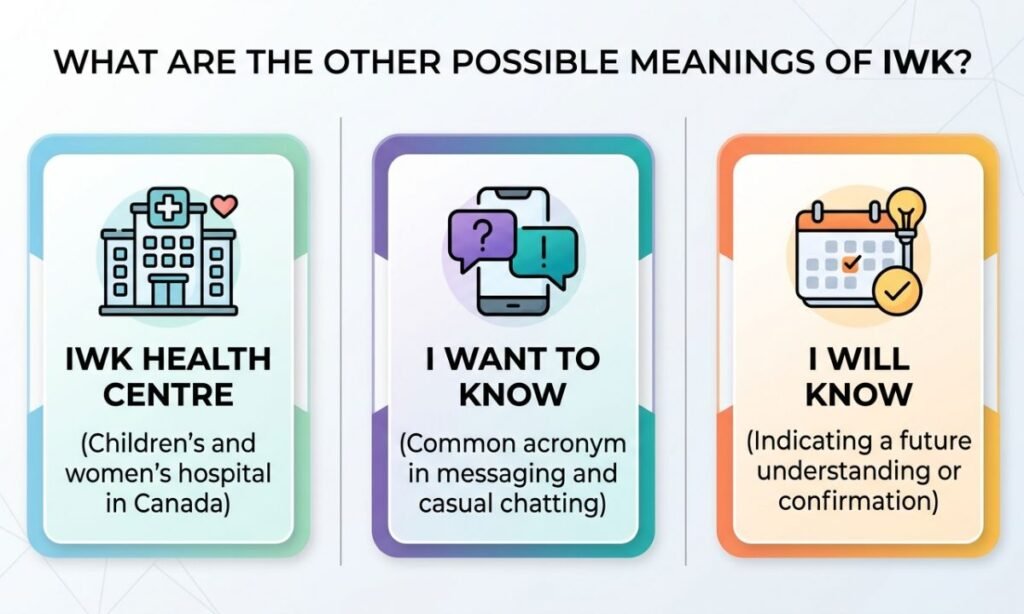
IWK meaning in text is clear in most chats, but the letters can point to other things outside texting.
A basic search shows several unrelated uses, such as the IWK Health Centre, a hospital in Halifax, Canada, and Indah Water Konsortium, a Malaysian sewerage company.
Some sites also list “I don’t know” as a meaning, but that is usually written IDK. If you see IWK in a casual chat right after a joke, “I was kidding” is almost always safe reading.
Context is your best guide. A joke before it points to “I was kidding.” A work document or a news article points to an organization.
The Origin and History of IWK
IWK did not arrive with a big announcement. Like most chat abbreviations, it grew out of people trying to type less and express more. There is no clear record of who first used it, so it is better to describe how the habit developed than to invent a date.
1. IWK in Early Internet Chat Rooms (2000s)
In the 2000s, chat rooms and instant messengers pushed people to type fast. Abbreviations like LOL, BRB, and JK became common because they saved time.
“I was kidding” fit this habit well. Jokes in plain text were easy to misread, so short clarifiers helped keep chats friendly.
2. The Rise of IWK on Social Media (2010-2020)
When social media took over, tone became even harder to read. Comments, captions, and group chats were full of sarcasm and banter.
During this time, short clarifiers spread across platforms. IWK appeared here and there, though it never grew as big as JK.
3. How IWK Is Used Today (2020-2026)
Today, IWK is a small, casual piece of slang. You will see it in direct messages, group chats, and gaming lobbies, mostly among friends who already joke around with each other.
It has not replaced older options like “jk” or “just kidding.” Think of it as one more way to say the same thing.
IWK Meaning in Text From a Boy
When a boy sends IWK, it usually follows a tease or a playful insult. Friends use it to keep banter from turning into an argument.
If it comes after a flirty line, it can also be a way to step back if he is not sure how the message landed. Look at the rest of the conversation before reading too much into it.
IWK Meaning From a Girl
From a girl, IWK often softens a joke or an honest comment. It can turn “you’re late again” into a playful nudge instead of a complaint.
Sometimes it hides a little truth. If the message before it sounded real, a gentle question like “Everything okay?” is better than ignoring it.
IWK Meaning in Text From a Guy
A guy using IWK is typically keeping things light. It often shows up after sarcasm, fake bragging, or a dramatic overreaction.
If a guy you are chatting with romantically adds IWK, he may be testing the mood. A friendly reply that matches his tone works best.
IWK Meaning Gen Z
For Gen Z, IWK belongs to a wider habit of clarifying tone in short messages. Gen Z texting is fast, ironic, and full of inside jokes, so people lean on small markers to avoid confusion.
That said, many Gen Z users prefer emojis, “jk,” or “/j” over IWK. When it does appear, it feels relaxed and a bit old-school.
IWK Meaning in Text Urban Dictionary
On crowdsourced slang sites like Urban Dictionary, entries are written by users, so they can vary. The usual submission for IWK meaning in text is “I was kidding,” matching what you see in everyday chats.
Treat these sites as a rough guide, not a final authority. Reading the surrounding messages tells you more than any single entry.
IWK Meaning Instagram
On Instagram, IWK appears in comments, captions, and DMs. A creator might post a dramatic caption and add IWK to show it was all for fun.
In DMs, it works the same way as in text messages. It cools down a joke or a spicy reply.
IWK Meaning TikTok
TikTok comment sections move quickly and thrive on sarcasm. People use IWK under videos to clarify an exaggerated opinion or a mock complaint.
You may also see it in replies between friends who tag each other. The tone is almost always playful.
IWK Meaning in Snap
On Snapchat, messages are short and disappear quickly, so there is little room for explaining. IWK fits perfectly as a fast clarifier after a teasing snap or a chat message.
It is common between close friends who send quick, casual replies all day.
IWK Meaning in Text Funny
IWK can also be a punchline. A person says something wildly dramatic, waits a beat, and then drops IWK to land the joke.
For example, “I’m moving to another country because you didn’t text back. IWK.” The humor comes from the over-the-top setup and the casual reveal.
How People Use IWK in Real Conversations
IWK is useful because it is quick and flexible. It works as a tone fixer, a joke finisher, and a polite way to back away from something that sounded too sharp.
Common Ways IWK Is Used in Texting
Here are the most common situations where people use IWK:
- After a friendly joke or tease
- After a fake threat or dramatic statement
- To soften a blunt opinion
- To clear up sarcasm that may be misread
- To step back from a comment that landed badly
Real-Life IWK Examples With Explanations
The examples below show how IWK works in different settings. Each one includes a short explanation so you can see why the writer used it.
Example 1: Using IWK After a Friendly Joke
Person A: Your cooking is so bad that the smoke alarm applauds.
Person A: IWK, it was actually pretty good.
Explanation: The first line is a joke. IWK makes sure the friend does not take it as an insult.
Example 2: Using IWK After a Fake Threat
Person A: If you spoil the ending, I’m deleting your number.
Person B: Harsh.
Person A: IWK, just don’t spoil it.
Explanation: The threat is clearly exaggerated, but IWK removes any doubt.
Example 3: IWK in a Social Media Comment
Comment: This is the worst haircut I’ve ever seen. IWK, it looks great!
Explanation: The commenter starts with a harsh joke and fixes it right away. Public comments are easy to misread, so the clarifier helps.
Example 4: IWK in a Gaming Chat
Player 1: You just lost us the match, uninstall the game.
Player 1: IWK, good try.
Player 2: Haha, my bad.
Explanation: Gaming chat can get heated fast. IWK keeps the mood friendly.
Short Conversations Featuring IWK
Short dialogues show how IWK works across a full exchange. They also give you ideas for how to reply.
Dialogue 1: Using IWK in Conversation
Person A: I’m not coming to your birthday party.
Person B: What? Why?
Person A: IWK. I’ll be there with cake.
Person B: You had me worried for a second.
Dialogue 2: Another Example of IWK
Person A: Your new profile picture is terrible.
Person B: Wow, thanks.
Person A: IWK, you look great.
Person B: Better. Don’t scare me like that.
Dialogue 3: IWK in a Casual Chat
Person A: I’m quitting my job to become a full-time cat influencer.
Person B: Seriously?
Person A: IWK. Though my cat does have the audience for it.
Person B: Honestly, I’d follow.
Personality Traits Commonly Associated With IWK Users
Slang choices do not define a person, and these are only general patterns. Still, people who often use IWK tend to share a few communication habits.
1. A Playful Personality
People who use IWK enjoy humor and banter. They like teasing, but they also want to be sure no one gets hurt.
2. A Friendly Communication Style
IWK shows care for the other person’s feelings. The writer is saying, “I made a joke, and I do not want you to misread it.”
3. A Casual Approach to Communication
IWK is informal, so users are often relaxed and comfortable with short, quick messages. They usually skip formal wording in everyday chats.
4. Active Use of Social Media
People who spend time on Instagram, TikTok, Snapchat, and group chats pick up small clarifiers quickly. They adjust their tone to suit each platform.
5. An Emotionally Expressive Communication Style
Using IWK signals that the writer pays attention to emotion and tone. They want their words to land the right way.
When Should You Use IWK? Understanding the Context
Use IWK when you have made a joke that could be misread, especially in text where the other person cannot hear your voice. It works well with friends, siblings, classmates, teammates, and people who share your sense of humor.
It is also helpful when you want to ease tension quickly. A fast IWK can save you from a long apology.
Situations Where You Should Avoid Using IWK
Skip IWK in serious or formal situations. Avoid it in work emails, school submissions, customer service messages, and professional chats with managers or clients.
Do not use it after something truly hurtful either. Adding IWK after a mean comment rarely fixes the damage, and it may make the other person feel worse.
IWK vs. Similar Text Abbreviations: Comparison Table
IWK has several close relatives. This table shows how they compare.
| Term | Meaning | Common Context | Tone |
| IWK | I was kidding | After a joke or tease | Light, casual |
| JK | Just kidding | Everywhere, very common | Light, quick |
| IJS | I’m just saying | After an honest opinion | Soft, sometimes defensive |
| LOL | Laughing out loud | Reacting to something funny | Friendly |
| IDK | I don’t know | Answering a question | Neutral |
| /j | Joking (tone tag) | Online communities, forums | Clear, neutral |
The main difference is timing. IWK looks back at something you already said, while JK is often used in the same way but is far more widely recognized.
How IWK Is Used in Modern Texting in 2026
In 2026, texting leans on emojis, voice notes, and short replies. IWK still has a small place in that mix, mostly among friends who like clear, quick jokes.
It is not a trending term. It is a practical one that people reach for when they want to clarify tone fast.
Modern Examples of IWK Usage
Person A: Your playlist is a crime against music.
Person A: IWK, send me the link.
Person B: Ha, I knew you’d come around.
Here is another one:
Person A: Congrats on being late to your own surprise party. IWK, we’re glad you came.
Why People Still Use IWK Today
People still use IWK because plain text hides tone. A joke that sounds funny in your head can sound cold on a screen.
IWK is also short, easy to type, and easy to understand once you know it. That makes it a handy tool in busy chats.
Common Mistakes People Make When Using IWK
Small slang can cause big misunderstandings. These are the mistakes to watch for.
1. Assuming the Message Is Meant Seriously
If the line before IWK sounded serious, do not panic. The sender is telling you it was a joke. Read the whole message before reacting.
2. Using IWK in Formal Messages
IWK does not belong in emails to your boss or in school assignments. Write “I was joking” or leave the joke out entirely.
3. Confusing IWK With Other Acronyms
Some people mix it up with IDK, IWY, or IWKMS. These letters look alike but mean different things, so always check the context.
4. Using IWK Too Frequently
If you add IWK after every sentence, your jokes lose their punch. Use it only when the tone could really be misunderstood.
Common Misconceptions About the Meaning of IWK
A few myths about IWK keep spreading. Here is the truth behind each one.
Misconception 1: IWK Is Extremely Popular Slang
IWK is known, but it is nowhere near as common as LOL or JK. Many people have never seen it, so do not assume everyone will understand it.
Misconception 2: IWK Has Only One Meaning
In texting, “I was kidding” is the main meaning. Outside chats, the same letters can refer to organizations or other terms, so context matters.
Misconception 3: IWK Is a New Slang Term
IWK is not a brand-new trend. Clarifiers like it follow the same pattern as older chat abbreviations, which have been around since early online messaging.
Frequently Asked Questions
What does IWK mean in text?
It means “I was kidding.” People use it to show that a previous message was a joke.
What does IWK stand for?
IWK stands for “I was kidding.” Each letter represents one word in that phrase.
Is IWK the same as JK?
They carry the same idea, but JK means “just kidding” and is much more common. IWK is rarer and slightly more casual.
How do you reply when someone sends IWK?
Match their tone. A simple “haha okay” or “you had me for a second” works well.
Can IWK be sarcastic?
Yes. Sometimes it follows sarcasm, so the meaning depends on the earlier message and the mood of the chat.
Is IWK rude?
No, it is meant to soften a joke. It can feel rude only if it follows a hurtful remark.
Is IWK used on TikTok and Instagram?
Yes, though not often. You may see it in comments, captions, and DMs where people joke around.
Should I use IWK in formal messages?
No. Stick to full sentences in professional or school settings.
Does IWK mean “I don’t know”?
Not usually. “I don’t know” is normally written as IDK, so IWK after a joke means “I was kidding.”
Conclusion
IWK meaning in text comes down to one phrase: “I was kidding.” It is a quick way to show that a joke, tease, or dramatic line was never meant seriously.
From friendly chats to Instagram comments, TikTok replies, and Snapchat messages, it helps keep tone clear when you cannot use your voice.Use it with friends, skip it in formal settings, and do not rely on it to undo something hurtful.
Now that you know the IWK meaning in text, you can read it with confidence, reply naturally, and use it only when it truly helps your message land the right way.

Hi, I’m Alex Carter, a passionate content creator and language enthusiast dedicated to exploring the true meanings behind words, phrases, and modern slang. With over 5 years of experience in content research and digital publishing, I specialize in breaking down complex terms into simple explanations. I focus on delivering well-researched, up-to-date, and SEO-optimized content that answers real user queries.