

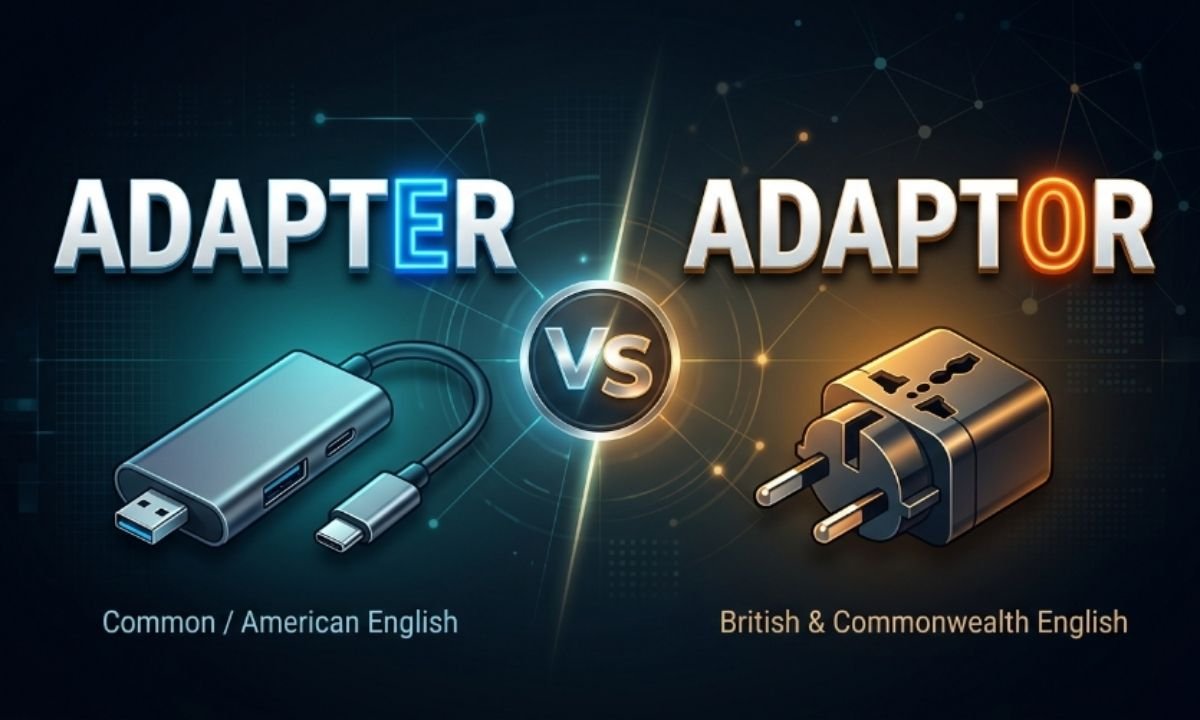
Adapter vs Adaptor is one of the most searched spelling questions in English, and if you’ve ever paused mid-sentence wondering which one to type, you’re not alone. Both words look almost identical, sound exactly the same, and yet somehow manage to confuse writers, students, and even native speakers every single day.
The good news? The confusion is easier to clear up than you’d think. In this guide, we’ll break down what each spelling means, where each one comes from, and how to pick the right one depending on your audience, region, and industry.
What is an Adapter?
An adapter is a device or tool that allows two otherwise incompatible things to work together. Think of a plug that lets your laptop charger fit into a foreign wall socket, or a small connector that lets an old cable work with a new device.
This spelling with an “-er” ending is the dominant form in American English. It’s also the version you’ll see most often in tech manuals, online stores, and global product listings, regardless of the writer’s home country.
Key uses of “adapter” include:
- A physical device that connects or converts electrical plugs, ports, or signals
- A person or system that adjusts to new conditions (rare, but valid usage)
- Software components that let two programs “talk” to each other
What is an Adaptor?
An adaptor means exactly the same thing as an adapter, a device that bridges the gap between two incompatible systems. The only real difference is the spelling, with an “-or” ending instead of “-er.”
This version is more common in British, Australian, and other Commonwealth English varieties. You’ll spot it in UK product packaging, British newspapers, and some technical and scientific writing that follows British style conventions.
So when comparing adapter vs adaptor at the definition level, there’s genuinely no gap in meaning, just a difference in spelling convention tied to region and publishing style.
Adapter vs Adaptor: Key Difference
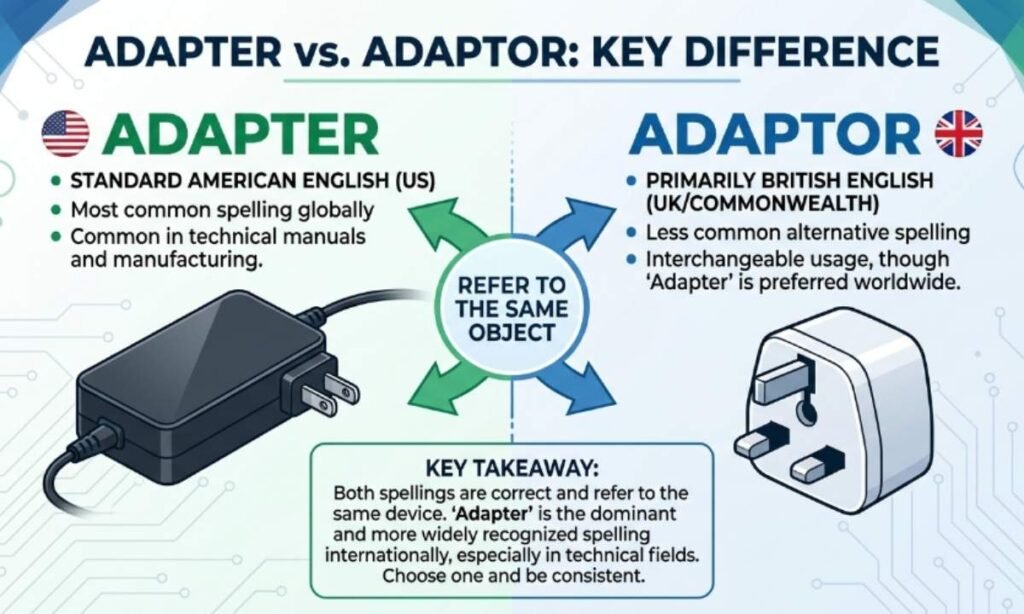
Here’s a simple table to visualize the adapter vs adaptor comparison at a glance:
| Feature | Adapter | Adaptor |
| Spelling ending | -er | -or |
| Common region | American English | British/Commonwealth English |
| Popularity | More widely used globally | Less common, regionally specific |
| Meaning | Device that connects/converts | Same as adapter |
| Used for people | Occasionally (someone who adapts) | Rarely |
| Tech industry preference | Dominant | Occasional, mostly UK brands |
The takeaway from this adapter vs adaptor breakdown is simple: pick one spelling and stay consistent throughout your writing.
Is it an Adapter or an Adaptor?
Both are correct. Neither spelling is “wrong,” and dictionaries recognize both forms. The real question isn’t grammatical correctness, it’s about matching your audience’s expectations.
If you’re writing for a US audience, “adapter” is the safer, more expected choice. If you’re writing for a UK, Australian, or Indian audience, “adaptor” may feel more natural and familiar to readers.
Why Are There Two Spellings?
English has a long history of absorbing Latin-based words and then splitting them into regional variants over time. Both “adapter” and “adaptor” trace back to the Latin verb adaptare, meaning “to fit” or “to adjust.”
As English spread and standardized differently across countries, spelling conventions diverged. A few reasons behind the adapter vs adaptor split include:
- Latin root ambiguity Latin agent nouns could end in either “-or” or “-er,” and English inherited both patterns unevenly.
- Regional dictionary standardization American dictionaries leaned toward “-er,” while British publishing houses often preferred “-or.”
- Industry habits Early 20th-century American technical writing popularized “adapter,” while British engineering and scientific texts favored “adaptor.”
- Global tech dominance As American tech companies scaled worldwide, “adapter” became the more visible spelling internationally.
Is “Adapter” or “Adaptor” the Correct Word to Use in British English?
In British English, both spellings technically appear, but “adaptor” is the more traditional and commonly accepted form especially for physical devices like plug adaptors and travel adaptors. That said, “adapter” is increasingly common in the UK too, largely due to global product labeling and American tech influence.
Where Are Adapter and Adaptor Used?
The adapter vs adaptor question isn’t confined to grammar books it plays out across several real-world industries.
The adapter vs adaptor spelling shows up across many industries. Here’s where you’ll encounter it most:
1. Electronics
Power adapters, chargers, and plug converters are labeled with either spelling depending on the manufacturer’s regional base.
2. Networking
Network adapters (like Wi-Fi or Ethernet adapters) almost always use the “-er” spelling, even in British technical documentation, because networking terminology tends to follow American conventions.
3. Software
In programming, the “adapter pattern” is a well-known design pattern used to make incompatible interfaces work together. This term is standardized as “adapter” in nearly all coding documentation worldwide.
4. Mechanical Engineering
Mechanical adaptors such as pipe fittings or hose connectors sometimes use the “-or” spelling in British and Commonwealth engineering manuals.
5. Everyday Devices
From phone chargers to kitchen appliances, everyday consumer products use both spellings depending on where the product was made or sold.
Adapter or Adaptor: Oxford Dictionary
The Oxford Dictionary lists both “adapter” and “adaptor” as correct, with “adapter” noted as the more frequently used form overall, even in British English contexts. Oxford references confirm that the meaning doesn’t change based on spelling; it’s purely a stylistic and regional distinction.
Understanding these industry patterns makes the adapter vs adaptor choice much easier context and audience matter more than any hard grammar rule.
Real-Life Examples of Adapter vs Adaptor
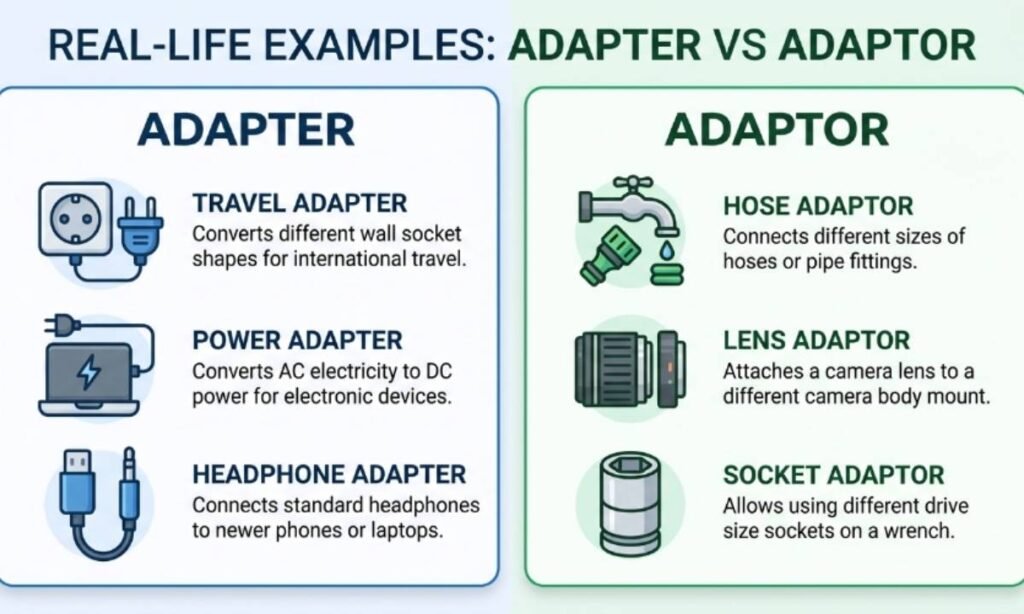
- “I need a travel adapter for my trip to Europe.” (American usage)
- “Don’t forget to pack a plug adaptor before you fly.” (British usage)
- “The software adapter connects the two APIs seamlessly.” (Universal, coding context)
- “She adapted quickly, becoming the perfect adapter for the new team structure.” (Person-related, rare)
Adapter vs Adaptor in Technology
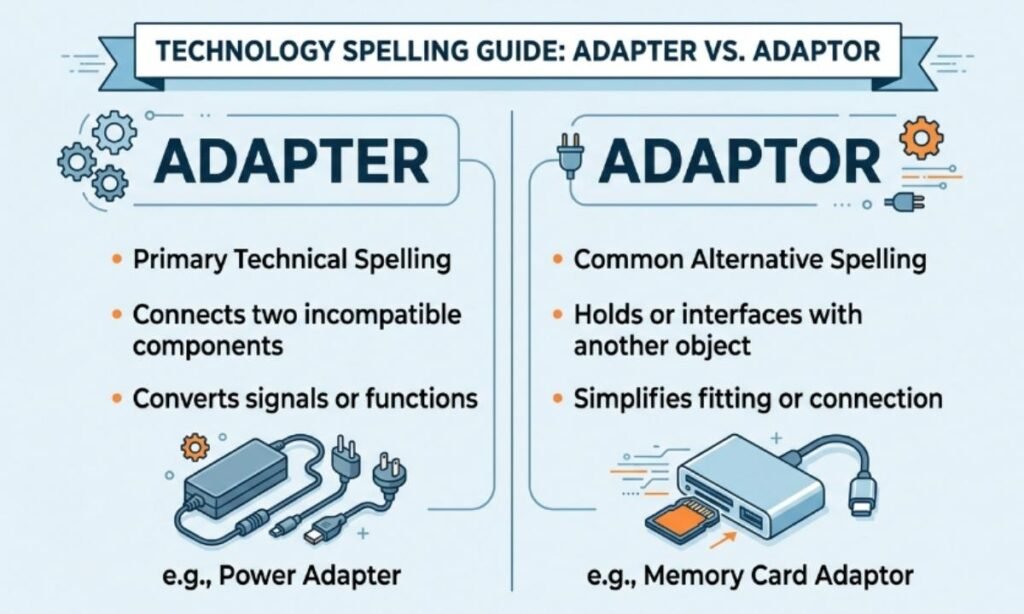
In the tech world, “adapter” wins by a wide margin. Search engine data, product listings, and developer documentation overwhelmingly use “adapter,” even on websites hosted in the UK. This is largely because:
- Global tech brands (Apple, Samsung, Dell, HP) default to American spelling
- Coding and engineering documentation standardizes on “adapter”
- SEO and product search trends favor the more commonly searched spelling
Which One Should You Use?
Use “Adapter” when:
- You’re writing for a global or American audience
- You’re creating technical, coding, or software documentation
- You want the spelling most recognized in search engines and product listings
- You’re unsure which one to pick (it’s the safer default)
Use “Adaptor” when:
- You’re writing specifically for a British, Australian, or Commonwealth audience
- Your brand or publication follows a British style guide
- You’re referencing UK-based product packaging or mechanical engineering terms
Is There Any Difference in Meaning?
Many readers ask this exact question when researching adapter vs adaptor, hoping there’s a hidden rule they’ve missed. No. Despite the popular myth that “adapter” refers to people and “adaptor” refers to devices, there’s no strong linguistic evidence supporting this rule.
Style guides like Fowler’s Modern English Usage note that this distinction isn’t widely observed, and both spellings are used interchangeably for people, devices, and software alike.
Common Types of Adapters
Whichever side of the adapter vs adaptor debate you land on, it helps to know the most common categories you’ll come across in daily life and shopping.
Power Adapter
Converts electrical voltage or current so a device can safely draw power from an outlet.
USB Adapter
Allows one type of USB connector (like USB-C) to work with another (like USB-A).
Network Adapter
A hardware component that connects a computer to a network, either via cable or wirelessly.
Audio Adapter
Converts audio signals or connector types, such as a headphone jack adapter.
Adaptor Person
In rare, informal usage, a person who quickly adjusts to new environments or roles is sometimes called an “adaptor” or “adapter,” though this usage is uncommon in modern writing.
Travel Adapter
Lets travelers plug their devices into foreign electrical outlets that use different plug shapes or voltages.
Adaptor Plug
A small device that changes the shape of a plug so it fits into a different type of socket common in British English product naming.
Adapter or Adaptor Laptop
Laptop chargers are almost universally labeled “adapter,” regardless of the country of sale, due to global tech branding conventions.
Adapter or Adaptor Charger
Phone and device chargers follow the same pattern “adapter” dominates packaging and marketing copy worldwide, even in the UK.
Adapter vs Adaptor in SEO Writing
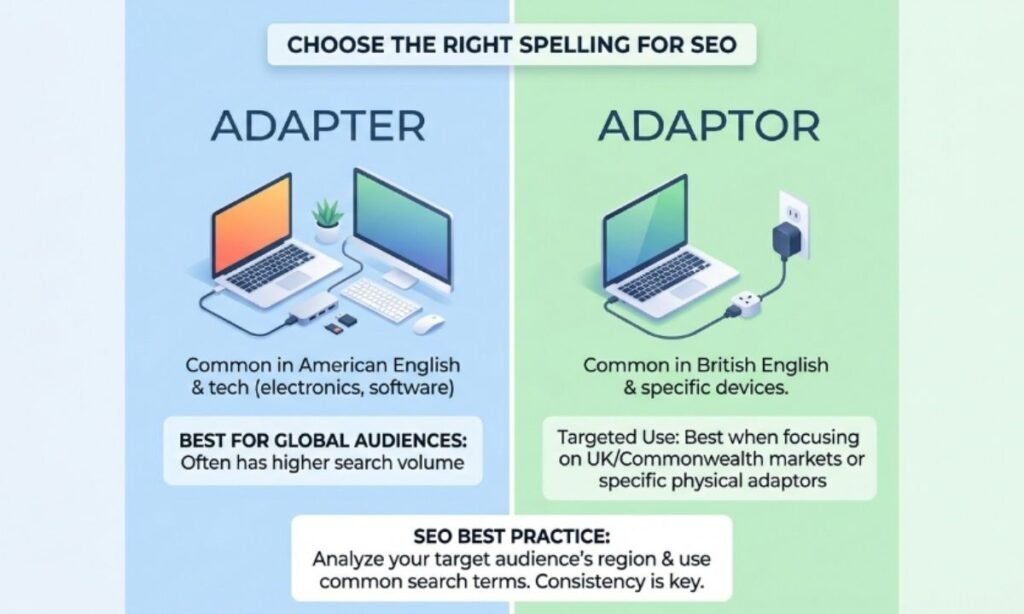
Content creators researching adapter vs adaptor for blog posts and product pages should pay close attention to how search intent shapes keyword choice.
SEO Insight:
Search volume data consistently shows “adapter” receiving significantly more searches than “adaptor,” even in countries where British spelling is standard. This makes “adapter” the stronger keyword choice for most content strategies.
Best Practice:
- Use “adapter” as your primary keyword for broader reach
- Mention “adaptor” once or twice to capture UK-based search traffic
- Keep spelling consistent within a single article to avoid confusing readers
Why Adapter is More Popular
If you look at global search trends around adapter vs adaptor, “adapter” consistently pulls ahead, which is why most content creators default to it.
“Adapter” has become the dominant global spelling because of the sheer scale of American tech influence, international product manufacturing, and search engine behavior. Even non-American companies often default to “adapter” in packaging and marketing to align with global audience expectations.
Advantages of Using Adapters
Regardless of which spelling you prefer in the adapter vs adaptor discussion, the practical benefits of using these devices stay exactly the same.
- Compatibility Lets incompatible devices, plugs, or systems work together
- Convenience Eliminates the need to buy new devices when traveling or upgrading tech
- Cost savings Extends the life of existing equipment instead of replacing it
- Flexibility Works across multiple device types, from chargers to network hardware
- Portability Compact adapters make travel and remote work easier
FAQs
What’s the quickest way to remember adapter vs adaptor?
Think “-er” for American English and “-or” for British English that simple pattern covers most cases.
Is adapter or adaptor correct?
Both are correct. “Adapter” is standard in American English, while “adaptor” is more common in British English.
What is the difference between adapter and adaptor?
There is no difference in meaning only a spelling variation based on regional English preferences.
Which spelling is used in the UK?
British English traditionally favors “adaptor,” though “adapter” is also widely understood and increasingly used.
Which spelling is used in the US?
American English almost exclusively uses “adapter” across writing, tech, and product labeling.
Is “adaptor” a real word?
Yes, “adaptor” is a legitimate, dictionary-recognized spelling with the same meaning as “adapter.”
Does adapter mean a person who adapts?
Occasionally, but this usage is rare and not a strict rule both spellings can technically apply to people or devices.
What is a power adapter used for?
A power adapter converts electrical voltage or current so a device can safely receive power from an outlet.
Why do tech companies use “adapter” instead of “adaptor”?
Because “adapter” is the globally recognized spelling, driven largely by American tech dominance and search trends.
Can I use both spellings in the same document?
It’s best to pick one spelling and stay consistent throughout your writing for clarity and professionalism.
Conclusion
At its core, the adapter vs adaptor debate isn’t really about right or wrong it’s about regional preference and audience expectations. Both spellings share the same Latin roots, the same pronunciation, and the same core meaning: a device (or occasionally a person) that bridges the gap between two incompatible systems.
If you’re writing for a global or American audience, “adapter” is the safer, more search-friendly choice. If your readers are primarily British or from Commonwealth countries, “adaptor” will feel more natural. Whichever you choose, the golden rule remains the same stay consistent, know your audience, and don’t let a one-letter difference slow down your writing.

Hi, I’m Alex Carter, a passionate content creator and language enthusiast dedicated to exploring the true meanings behind words, phrases, and modern slang. With over 5 years of experience in content research and digital publishing, I specialize in breaking down complex terms into simple explanations. I focus on delivering well-researched, up-to-date, and SEO-optimized content that answers real user queries.