

Requester vs. Requestor is one of those word pairs that trips up even experienced writers, and if you’ve landed here searching for a clear answer, you’re not alone. Both spellings show up in emails, legal forms, IT tickets, and everyday conversation, and most people simply guess which one is “correct” without ever getting a straight answer. This guide settles the Requester vs. Requestor debate for good, walking through meaning, origin, regional preference, and real-world usage so you never second-guess your spelling again.
By the end of this article, you’ll know exactly when to use each spelling, why both exist in modern English, and how to avoid the small but common mistakes that make writing look inconsistent — everything you need to finally close the Requester vs. Requestor debate.
Requester vs. Requestor — Meaning, Usage, and Correct Contexts
At the core of the Requester vs. Requestor comparison is a simple truth: both words describe the same thing — a person or entity that makes a request. Neither spelling is grammatically wrong, and dictionaries recognize both. The real difference comes down to frequency of use, regional habits, and industry context, not meaning.
That said, treating the two as fully interchangeable in every situation can backfire, especially in technical documentation or legal writing where consistency matters. Understanding the nuances behind Requester vs. Requestor helps you choose the spelling that fits your audience and keeps your writing polished.
The Meaning and Usage of “Requester” and “Requestor”
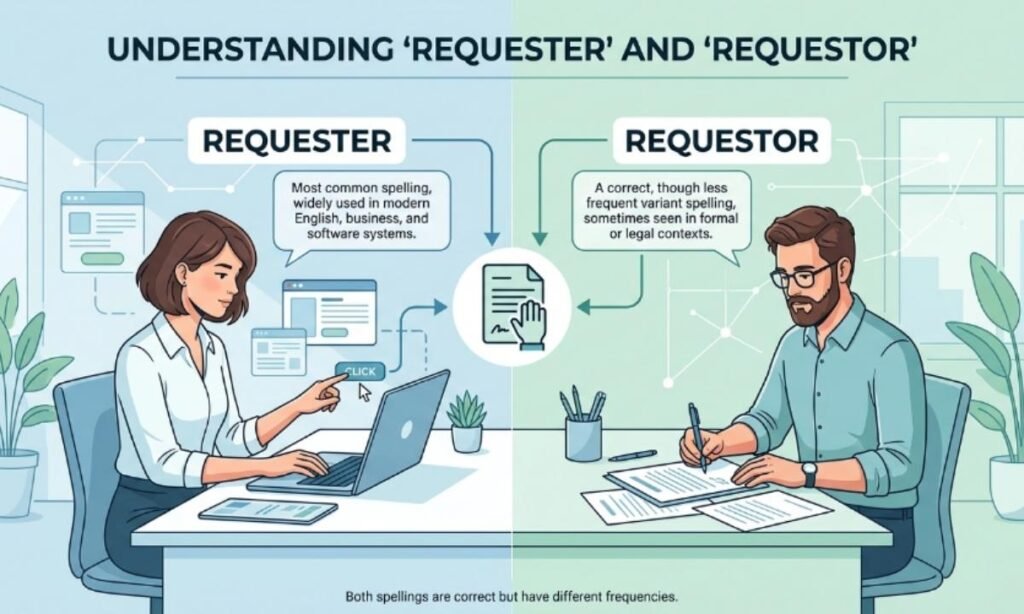
Both terms are agent nouns built from the verb “request” — a word that means to ask formally for something. Agent nouns describe the person performing an action, and English typically forms them with either “-er” or “-or.” That grammatical overlap is exactly why the Requester vs. Requestor confusion exists in the first place.
Requester
A requester is a person who submits a request for information, access, service, or action. This is the version most people encounter daily — in customer service emails, HR forms, workplace software, and casual writing.
Examples:
- The requester filled out the online form before noon.
- Customer support replied to the requester within two hours.
- Each requester must confirm their identity before submission.
“Requester” follows the familiar English pattern seen in words like teacher, builder, and worker, which is a major reason it feels more natural to native speakers.
Requestor
A requestor refers to the exact same role — someone asking for something — but the spelling leans on the older “-or” agent-noun ending, similar to words like “auditor” or “contractor.” It shows up less frequently overall but remains common in formal, legal, and technical writing.
Examples:
- The requestor submitted a formal application for system access.
- As the requestor, you are responsible for providing accurate documentation.
- The database logs the requestor’s ID for every transaction.
Neither version changes the underlying meaning — a requestor is still simply someone who requests something.
Key Difference Between Requester and Requestor
| Aspect | Requester | Requestor |
| Meaning | Person who makes a request | Person who makes a request |
| Common region | American English (dominant) | Used globally, more formal tone |
| Typical context | Everyday writing, business emails, customer service | Legal documents, IT systems, procurement, government forms |
| Word formation | “-er” agent suffix (like teacher, builder) | “-or” agent suffix (like auditor, contractor) |
| Frequency online | More common | Less common |
| Tone | Neutral, conversational | Formal, technical |
The takeaway from the Requester vs. Requestor comparison is straightforward: pick “requester” for general use, and reserve “requestor” for specialized or system-specific writing where it’s already the established term.
Synonym for Requester
If you want to avoid repeating “requester” too often in a piece of writing, several close synonyms work well depending on context:
- Applicant
- Petitioner
- Claimant
- Asker
- Inquirer
- Solicitor (in certain formal or legal contexts)
Choose based on tone — “applicant” fits forms and applications, while “petitioner” suits legal or governmental writing.
Requester Opposite
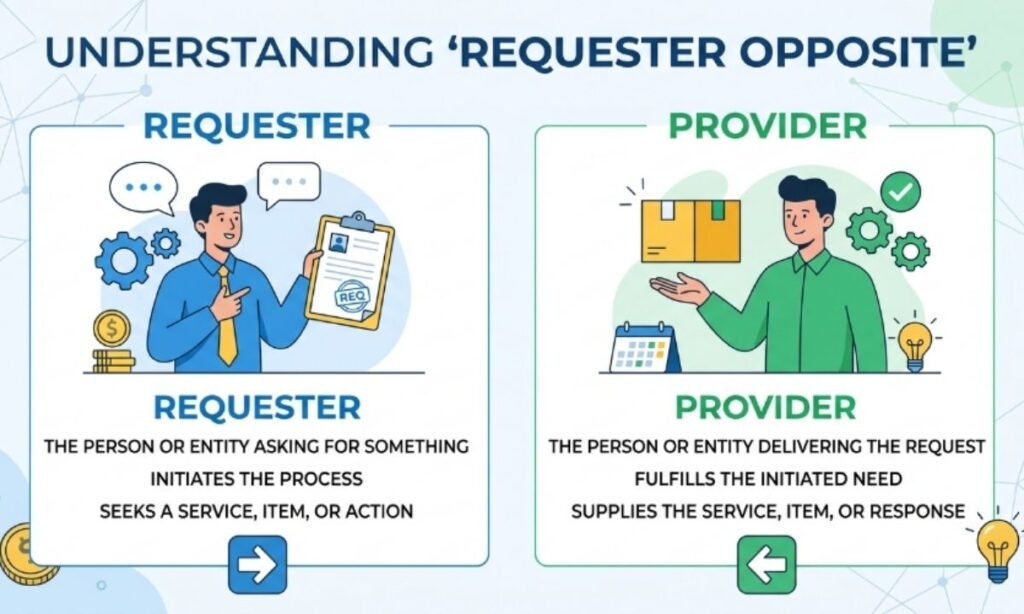
The natural opposite of a requester is the party who receives and acts on the request. Common opposite terms include:
- Approver
- Grantor
- Provider
- Responder
- Fulfiller
In workflow systems, you’ll often see “requester” paired directly with “approver,” since one initiates the action and the other authorizes it.
Exploring the Prevalence of “Requester” in American English
American English has clearly favored “requester” for decades, and search data, style guides, and published writing all reflect that trend. The “-er” ending simply feels more intuitive to English speakers because it mirrors thousands of everyday agent nouns.
Examples in American English
- The IRS uses “requester” in official tax-related documents.
- Corporate HR systems label the initiating employee as the “requester.”
- News articles and blogs almost exclusively use “requester” over “requestor.”
Common Examples and Usage in Daily Language
In daily conversation and writing, “requester” appears in contexts such as:
- Workplace ticketing systems (“Assign this ticket to the requester”)
- Customer service platforms
- Everyday emails asking for approval or information
- General business correspondence
This everyday dominance is a major reason “requester” wins the Requester vs. Requestor comparison in casual and professional American writing alike.
Impact of Language Trends on Word Preference
Language doesn’t evolve randomly — several real forces are pushing “requester” further ahead in modern usage.
1. Digital communication simplifies language
Fast-paced digital writing, from Slack messages to support tickets, favors the spelling that feels most natural to type and read. “Requester” wins simply because it matches the pattern people already know.
2. American English influences global usage
Because so much software, media, and business content originates in the U.S., American spelling conventions — including “requester” — spread internationally through tech platforms and global companies.
3. Style guides encourage consistency
Major editorial style guides recommend “requester” as the default spelling for general content, pushing writers, editors, and content teams toward a single standard.
Requestor in British English and Specialized Contexts
Interestingly, the Requester vs. Requestor divide isn’t strictly American versus British. British English uses both spellings too, but “requestor” tends to survive longer in formal legal and institutional documents, partly due to older Latin-influenced spelling conventions still present in UK legal drafting.
Examples of Requestor in Specialist Contexts
Legal Contexts
- “The requestor must provide valid identification before records are released.”
- Freedom of Information (FOI) requests often refer to the individual as the “requestor.”
- Court filings sometimes use “requestor” to match older statutory language.
Technical Contexts
- API documentation frequently labels the calling system or user as the “requestor.”
- IT service management platforms (like ticketing and access-control systems) often hard-code “requestor” as a field name.
- Procurement and vendor management software commonly uses “requestor” for the employee initiating a purchase order.
Once a system defines “requestor” as an official field or role, that spelling should be used consistently throughout related documentation — even if “requester” is used everywhere else in the company. This is a common real-world Requester vs. Requestor scenario that trips up new employees.
How to Spell Requester
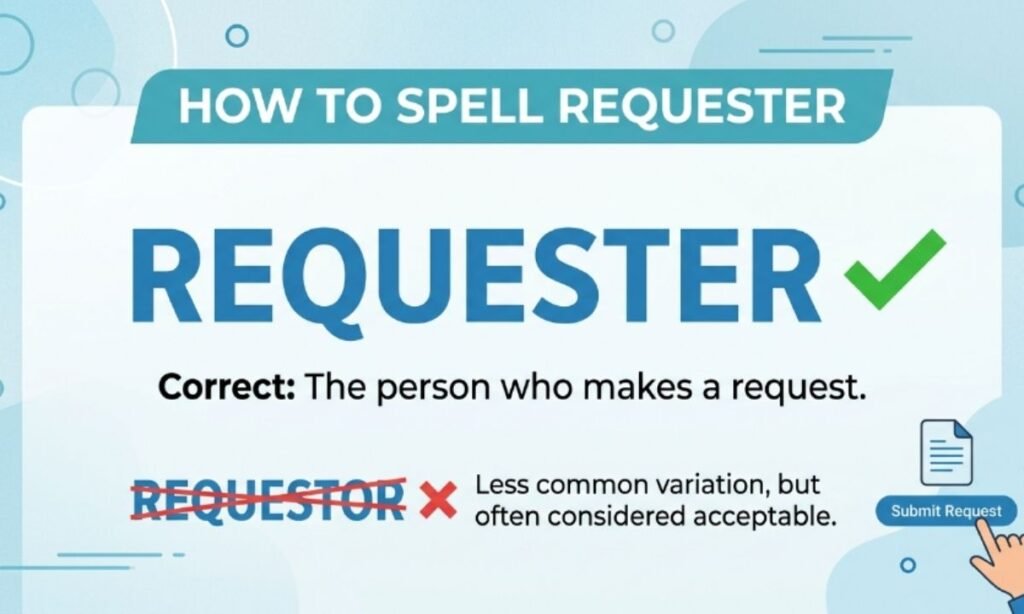
The correct standard spelling for general use is r-e-q-u-e-s-t-e-r. It follows the same “-er” pattern as hundreds of other English agent nouns. If you’re ever unsure which version to use in everyday writing, “requester” is the safer, more widely accepted choice in almost any Requester vs. Requestor situation.
Requester vs Requestor Reddit
Online discussions, including threads on Reddit and other forums, largely echo what dictionaries and style guides already confirm: both spellings are valid, “requester” is more common, and the choice often comes down to whichever term a specific company, system, or industry has already standardized. Many commenters note that once a workplace tool uses one spelling in its interface, employees naturally adopt that version in their own writing to stay consistent.
Requester” or Requestor UK
In the UK, general writing mirrors the American preference for “requester,” while formal, legal, and governmental documents are more likely to retain “requestor.” There’s no strict national rule — unlike, say, “colour” versus “color” — because this particular word pair isn’t a true British-versus-American spelling split. It’s more accurately described as a formality and industry split that happens to appear slightly more often in British legal writing.
Understanding Language Variations
Agent nouns in English don’t follow one universal rule. Some default to “-er” (teacher, writer), others to “-or” (actor, director), and a few — like this one — allow both. This flexibility is exactly why the Requester vs. Requestor question keeps coming up: the language itself never fully settled on one form, and that’s the heart of every Requester vs. Requestor debate you’ll find online.
Etymology and Evolution of the Term “Requester”
Historical Perspective of the Word “Request”
“Request” traces back to the Latin verb “requaerere,” meaning to seek or ask for again. It passed through Old French as “requeste” before entering Middle English. From there, English speakers naturally added agent-noun suffixes to describe someone performing the action — leading to both “requester” and “requestor” appearing over time.
The Emergence of “Requester” in Modern Usage
As English spelling gradually standardized, especially through print and later digital media, “-er” became the more frequently reinforced ending for new and existing agent nouns. “Requester” gained dominance not because “requestor” was incorrect, but because everyday usage and style conventions increasingly favored the “-er” form.
Practical Examples: How to Use “Requester” in Sentences
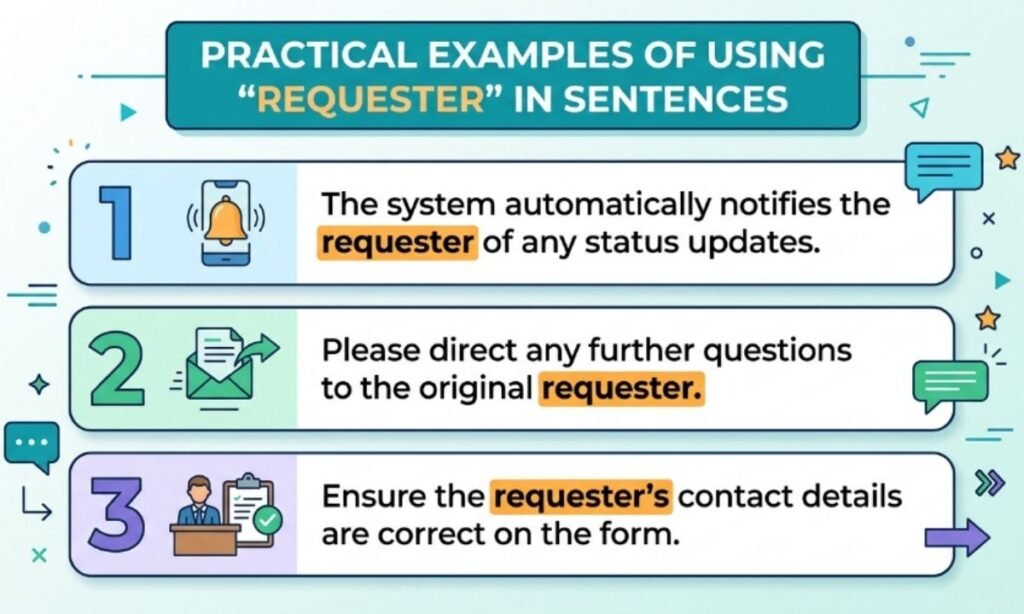
- The requester attached all supporting documents to the ticket.
- Please notify the requester once the item ships.
- As a requester, always double-check your submission for accuracy.
- The system automatically emails the requester with a confirmation number.
- The manager approved the requester’s time-off application the same day.
Common Mistakes and How to Avoid Them
Mixing spellings in the same document
Switching between “requester” and “requestor” within a single email, report, or webpage looks careless. Pick one spelling per document and stick with it unless a specific field name requires otherwise.
Switching spellings inside a system definition
If a software platform or legal form already defines “requestor” as an official field, don’t rename it to “requester” halfway through documentation. Consistency with the system’s terminology matters more than personal preference.
Thinking one spelling is “wrong”
Neither word is incorrect. The real mistake is assuming there’s a strict rule when the actual guidance is about context and consistency, not correctness.
Letting autocorrect decide for you
Spellcheckers sometimes flag “requestor” as an error simply because “requester” is more common in their dictionaries. Don’t let software silently override a term your industry or system specifically requires.
FAQs
Which is correct, requestor or requester?
Both are correct spellings with the same meaning. “Requester” is more common in general and American English, while “requestor” is more typical in legal and technical contexts.
Is requester the same as requestor?
Yes, they mean exactly the same thing — a person who makes a request. The difference is purely stylistic and contextual, not definitional.
Is it requester or requestor in British English?
British English uses both, but leans toward “requester” in everyday writing and “requestor” in formal legal or institutional documents.
Is there such a word as requester?
Yes, “requester” is a standard, dictionary-recognized English word describing someone who makes a request.
Is “requestor” grammatically correct?
Yes. “Requestor” is a legitimate agent noun formed the same way as words like “auditor” or “contractor,” and it’s widely accepted in formal and technical writing.
Which spelling should I use in a resume or cover letter?
Use “requester,” since it’s the more natural, widely recognized spelling for general professional writing.
Do IT systems always use “requestor”?
Not always, but many ticketing, procurement, and access-management platforms default to “requestor” as a field label, so check your specific system before assuming.
Can I switch between requester and requestor in casual writing?
It’s best not to. Even in casual writing, sticking to one spelling throughout keeps your content looking polished and professional. This is one of the simplest rules to remember in the entire Requester vs. Requestor discussion.
Why do two spellings exist for the same word?
English agent nouns can end in either “-er” or “-or,” and this particular word never fully standardized on one form, so both survived through different regions and industries — which is exactly why the Requester vs. Requestor question still comes up today.
Conclusion
The Requester vs. Requestor debate ultimately comes down to context, not correctness. Both words describe the same role — someone making a request — and neither spelling is a grammar mistake. “Requester” dominates everyday American English, business writing, and casual communication thanks to its familiar “-er” pattern, while “requestor” persists in legal, governmental, and technical systems where formality and established terminology matter more.
The smartest approach to Requester vs. Requestor isn’t memorizing a rigid rule — it’s recognizing your audience and staying consistent. Use “requester” as your default for general writing, and reserve “requestor” for the specialized contexts where it’s already the expected term. Get that balance right, and you’ll never trip over this word pair again.

Hi, I’m Alex Carter, a passionate content creator and language enthusiast dedicated to exploring the true meanings behind words, phrases, and modern slang. With over 5 years of experience in content research and digital publishing, I specialize in breaking down complex terms into simple explanations. I focus on delivering well-researched, up-to-date, and SEO-optimized content that answers real user queries.